
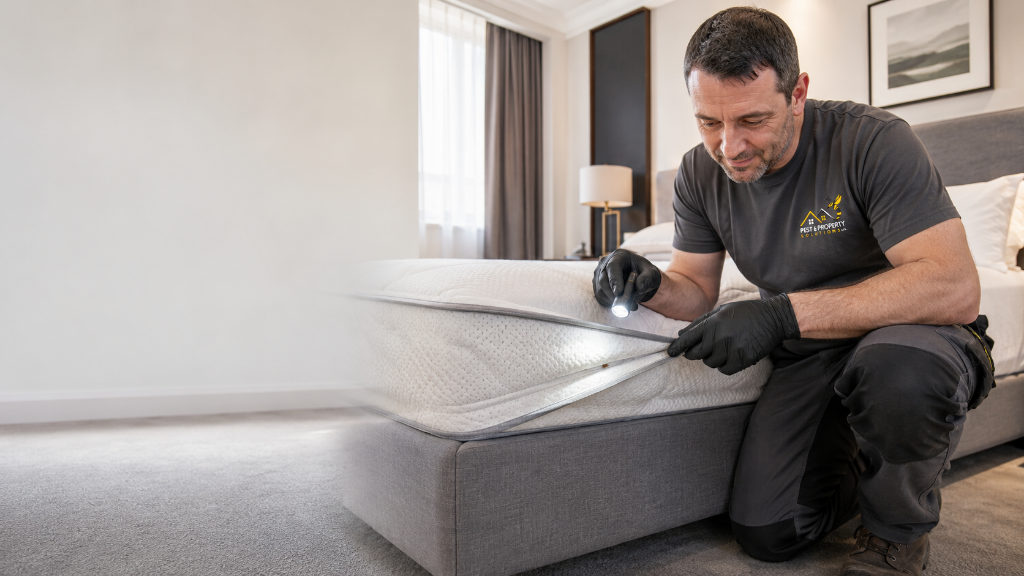
Bed bugs are small, reddish-brown insects around 5 to 7mm long, roughly the size of an apple seed. The clearest signs are dark spots on bedding, shed skins in mattress seams, a musty smell and clustered bites on exposed skin. They spread by hitchhiking in luggage and furniture, not by poor hygiene, and rarely clear without professional treatment.
What Are Bed Bugs?
Bed bugs are small, parasitic insects that feed exclusively on blood. Scientifically known as Cimex lectularius, they are one of the most resilient and difficult-to-eliminate household pests found across the UK. They do not fly, they cannot jump, and they are not a sign of a dirty home. They hitchhike, moving between locations in luggage, clothing, second-hand furniture, and bedding.
Bed bug infestations have been rising steadily across the UK in recent years, fuelled by international travel, second-hand furniture markets, and increased urban density. If you are in Cardiff or anywhere across Wales and suspect you have bed bugs, early identification is the single most important step you can take.
This guide covers everything you need to know about bed bug identification in the UK, from what they look like and how to spot the bites, to where they hide and what to do about it.
What Do Bed Bugs Look Like? A Visual Description
Bed bugs are often mistaken for other insects, which is why knowing exactly what to look for matters.
Adult bed bugs
Roughly 5 to 7mm long, about the size of an apple seed. They are flat, oval-shaped, and reddish-brown in colour. After feeding, their bodies become more elongated and darker, almost mahogany. They have six legs, two antennae, and no wings.
Nymphs (juvenile bed bugs)
Smaller and semi-translucent or pale yellow in colour, making them very difficult to spot with the naked eye. They become redder after feeding.
Bed bug eggs
Tiny, around 1mm, white, and pear-shaped. They are often found in clusters in crevices and are sticky, which means they cling to surfaces.
Signs of a Bed Bug Infestation
You may not see the insects themselves before you notice the evidence they leave behind. Here are the most reliable infestation signs to look for.
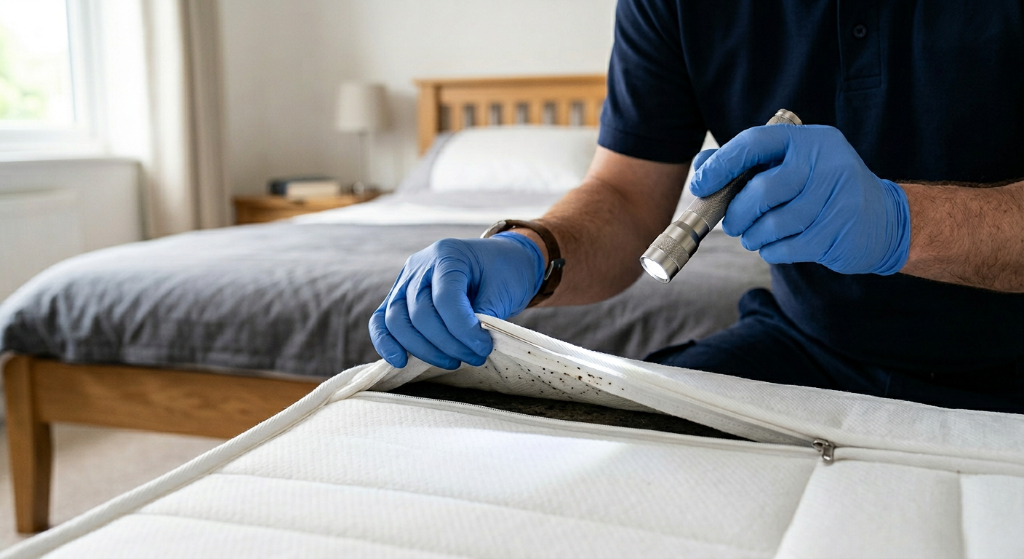
Dark or rusty spots on bedding and mattresses
These are bed bug excrement. You will often find small clusters of dark dots along mattress seams, on pillowcases, or on the bed frame. They can appear almost like a felt-tip pen smudge.
Bloodstains on sheets
Small reddish-brown smears caused by bugs being crushed while feeding, or from bites seeping slightly after they feed.
Shed skins (moult casings)
Bed bugs shed their exoskeleton five times as they grow. These pale, hollow casings are a reliable indicator of an active or historic infestation.
A musty, sweet odour
Heavy infestations sometimes produce a noticeable smell, often described as sweet, musty, or faintly similar to coriander or almonds. This comes from the bugs' scent glands.
Live or dead bugs
In severe infestations, you may find them in the seams of mattresses, behind headboards, inside electrical outlet covers, or in furniture joints.
How to Identify Bed Bug Bites
One of the most common reasons people suspect bed bugs is waking up with unexplained bites. However, bite identification is notoriously tricky because people react differently, and bites can resemble those from other insects.
What bed bug bites look like
Bed bug bites typically appear as small, raised, red welts. They are usually itchy and can become inflamed or swollen. Unlike flea bites, which cluster around the ankles, bed bug bites appear on exposed skin: arms, neck, face, shoulders, and hands. They are commonly found in a rough line or cluster pattern, sometimes called "breakfast, lunch, and dinner" bites, reflecting the bug's feeding habit of moving along a short path.
Key characteristics
- Small, red, raised bumps or flat welts
- Often appear in a row of three or more
- Itching can be intense and may worsen over 24 to 48 hours
- Some people show little or no reaction to bites, which can delay detection
- Bites may not appear immediately, it can take days for a reaction to develop
How to tell bed bug bites apart from other bites
Mosquito bites tend to appear randomly and are larger with a central wheal. Flea bites cluster around the lower legs and ankles. Scabies causes a persistent, widespread rash with a burrowing pattern. If your bites follow a linear or clustered pattern on exposed upper body skin and appear repeatedly each morning, bed bugs are the likely cause.
If you are experiencing a skin reaction and cannot identify the cause, speak to a GP or pharmacist. Antihistamines and topical hydrocortisone can help manage itching and swelling.
Where Do Bed Bugs Hide?
Bed bugs are nocturnal and photophobic, meaning they avoid light and hide in tight, dark spaces close to their host. They are not limited to beds, despite the name.
Bed Bugs in Hotels: What Guests Need to Know
Hotels are one of the most common ways bed bugs spread. High guest turnover, shared laundering, and interconnected rooms create ideal conditions for infestation.
What to do when you check in
Before you settle in, take two minutes to inspect the room. Pull back the sheets and check the mattress seams and piping for dark spots, shed skins, or live bugs. Lift the mattress slightly to check underneath. Inspect the headboard by pressing against the wall, many can be lifted away.
Do not place your luggage on the bed or floor. Use the luggage rack, ideally in the bathroom while you do your check. Keep your bags off soft surfaces throughout your stay.
If you find evidence of bed bugs
Report it to reception immediately and request a room change, ideally not adjacent to the original room. When you return home, inspect your luggage before bringing it inside, wash all clothes on a 60°C cycle, and tumble dry if possible. Vacuum your luggage thoroughly and consider leaving it in a bag in the car or garage for a few days.
Your rights as a hotel guest
Under the Consumer Rights Act 2015, services and accommodation should be provided with reasonable care and skill, and to a reasonable standard. A bed bug infestation is a serious failure to meet that standard. If the hotel refuses to act or dismisses your concerns, raise a formal complaint in writing, take photographs as evidence, and consider escalating to the relevant trade body or your local environmental health team.
Bed Bugs in Rental Properties: Landlord and Tenant Obligations
Bed bugs in rental properties are a sensitive and often contentious issue. The legal position in England and Wales is broadly as follows.
Landlord responsibilities
Under the Landlord and Tenant Act 1985 and the Housing Act 2004, landlords are required to ensure properties are fit for human habitation and kept in repair. An untreated bed bug infestation would likely be considered a serious hazard under the Housing Health and Safety Rating System (HHSRS). Landlords are generally responsible for treating infestations that were present at the start of a tenancy, or where the infestation originated from structural defects such as wall cavities connecting to other units.
Tenant responsibilities
If a tenant introduced the infestation through their own furniture, travel, or behaviour, responsibility may shift to the tenant. Tenants should report suspected infestations in writing as soon as possible to create a formal record.
For landlords in Cardiff and Wales
Since 1 December 2022, landlords in Wales have an additional duty under Part 4 of the Renting Homes (Wales) Act 2016 to ensure rented dwellings are fit for human habitation throughout the occupation contract, which includes addressing serious pest infestations such as bed bugs. Cardiff Council's Environmental Health team can advise on serious infestations in rental properties and can take enforcement action against landlords who fail to address pest control.
Practical advice for landlords
Inspect properties between every tenancy. Use mattress encasements on all beds. Brief tenants on what to look for. Address reports quickly, the longer a bed bug infestation is left, the harder and more expensive it becomes to treat.
Bed Bug Prevention: What You Can Do
Prevention is far easier than treatment. Here is how to reduce your risk.
At home
- Use mattress and pillow encasements designed to trap bed bugs
- Reduce clutter in bedrooms, fewer hiding places means easier inspection
- Vacuum regularly, including mattress seams, skirting boards, and upholstered furniture
- When buying second-hand furniture, inspect it thoroughly before bringing it indoors
- Wash bedding at 60°C or above regularly
After travelling
- Inspect your luggage before bringing it back inside
- Wash and tumble dry all clothing immediately
- Leave luggage in the hall, porch, or a sealed bag while you inspect
If you live in a flat or terrace
- Bed bugs can travel between units through wall cavities and electrical conduits
- If a neighbour has an infestation, yours is at risk
- Seal gaps around skirting boards, electrical outlets, and pipes where possible
Professional Bed Bug Treatment: What to Expect
Bed bugs are extremely difficult to eliminate without professional help. DIY sprays and over-the-counter products rarely reach the bugs in their hiding places and cannot penetrate eggs.
Chemical treatment
A qualified pest controller applies insecticide across all affected areas. Usually requires two or three treatments spaced two to three weeks apart to catch newly hatched nymphs. All bedding and clothing must be washed beforehand.
Heat treatment
Specialist equipment raises the room temperature to above 50°C for several hours. Heat penetrates mattresses, furniture, and wall cavities, killing bugs and eggs at all stages. It is a single-visit solution with no chemical residue, making it ideal for families with children or allergies.
Cryonite (CO2 freezing)
A non-toxic alternative using rapid freezing to kill insects on contact. Often used in combination with other methods.
What to look for in a professional pest controller
Choose a pest controller who is a member of the National Pest Technicians Association (NPTA) or holds an RSPH qualification. They should carry out a thorough survey before quoting, provide a written treatment plan, and offer a guarantee period. For Cardiff residents, local pest control services covering the CF3, CF14, CF23, and CF24 postcode areas can usually respond within 24 to 48 hours.
When to Call a Professional
Bed bugs are one of the hardest household pests to eliminate without professional help, and this is where DIY safely stops. Over-the-counter sprays and foggers rarely reach the eggs and adults tucked deep inside mattress seams, bed frames, skirting boards and behind sockets, and partial treatment simply scatters the problem to new rooms.
You should call a professional as soon as you have confirmed live bugs or fresh signs in more than one spot, if bites and evidence keep returning after cleaning, or if you live in a flat, HMO or terrace where bugs can travel between units. Professional treatment uses controlled heat or residual products that are not available to the public, applied over more than one visit to break the breeding cycle.
Pest & Property Solutions runs a discreet, multi-visit bed bug protocol across Cardiff and South Wales. The sooner it is treated, the smaller and less costly the job.
Key takeaways
- Bed bugs are about 5 to 7mm, reddish-brown and flat. They do not fly or jump, and they are not a sign of a dirty home.
- The most reliable evidence is what they leave behind: dark excrement spots, shed skins and blood smears in mattress seams and bed frames.
- They hitchhike in luggage, second-hand furniture and clothing, and can move between flats and terraces through wall cavities.
- Bites appear in lines or clusters on exposed skin, but bites alone are not proof. Confirm with physical signs.
- DIY sprays rarely reach the hiding places. A confirmed infestation almost always needs professional heat or residual treatment over more than one visit.
Frequently Asked Questions
How do I know if I have bed bugs or fleas?
Flea bites typically cluster around the ankles and lower legs. Bed bug bites appear on upper body exposed skin in lines or clusters. Fleas are dark, fast-moving, and jump. Bed bugs are flat, slow-moving, and cannot jump. Check your mattress seams, fleas do not live there.
Can bed bugs live in clean homes?
Yes. Bed bugs are not attracted to dirt or food waste. They are attracted to body heat and carbon dioxide. A clean, well-kept home is just as susceptible as any other.
How long can bed bugs survive without feeding?
Adult bed bugs can survive for several months without feeding in cooler temperatures. This means vacating a property does not eliminate an infestation.
Can I get rid of bed bugs myself?
In minor infestations, thorough vacuuming, heat treatment of bedding, and mattress encasements can reduce numbers significantly. However, professional treatment is recommended for any established infestation. Eggs and bugs in wall voids are virtually impossible to reach without specialist equipment.
How quickly do bed bugs spread?
A single mated female can produce a large number of eggs over her lifetime. Under warm conditions, eggs hatch within around one to two weeks and nymphs reach maturity within several weeks. An infestation can become severe within a few months.
Are bed bugs dangerous?
Bed bugs are not known to transmit disease. However, their bites can cause significant discomfort, allergic reactions in some people, and considerable psychological distress. Secondary skin infections from scratching are possible.
How much does professional bed bug treatment cost in the UK?
Costs vary depending on the size of the property and the treatment method. Chemical treatments typically start from around £200 to £400 for a single room. Heat treatments may cost £500 to £1,000 or more. Always get two or three quotes from NPTA-registered companies.
Need Help with Bed Bugs in Cardiff or South Wales?
If you suspect a bed bug infestation, do not wait. Early treatment is faster, more effective, and significantly cheaper than dealing with a well-established problem. Our team provides expert pest identification and professional bed bug treatment across Cardiff and the surrounding areas, including Roath, Canton, Pontcanna, Llandaff, Heath, Whitchurch, and the Vale of Glamorgan.
![[Professional headshot of Gareth Davies, branded uniform, plain or on-site background]](https://media.base44.com/images/public/6a030ac59700caa462b5b7c5/a28541072_gareth-caricature-rat-rifle-solid-black-bg.png)
Written by
Gareth Davies
Owner of Pest & Property Solutions
Gareth owns and runs Pest & Property Solutions. He sets the service standards, leads on inspections and complex jobs, and makes sure every customer gets practical, honest advice.
Expertise: Rodent control, Commercial pest control, Drain surveys and RatGate systems, Property inspections, Prevention and proofing
View full profile