What Is Commercial Pest Control Compliance?
If you run a business in the UK, pest control is not optional.
Whether you operate a restaurant in Cardiff city centre, a food production facility in Llantrisant, or a warehouse on an industrial estate in Newport, you have a legal duty to protect your premises, your staff, and the public from the risks pests create.
Commercial pest control compliance refers to the set of legal obligations, documentation requirements, and best practice standards that businesses must meet to manage pest risks effectively. Failing to comply can result in enforcement action, financial penalties, reputational damage, and in some cases, prosecution.
This guide explains what the law requires, what auditors and environmental health officers look for, and what you need to have in place to stay compliant.
The Legal Framework: What UK Law Requires
The Food Safety Act 1990
The Food Safety Act 1990 places a clear duty on food businesses to ensure that food is not exposed to contamination or rendered unsafe. Pest activity, whether from rodents, insects, or birds, directly threatens food safety. Local authorities have the power to issue improvement notices, emergency prohibition orders, and prosecute businesses that fail to meet food safety standards.
The Health and Safety at Work Act 1974
Employers are legally required to provide a safe working environment under the Health and Safety at Work etc. Act 1974. A pest infestation can expose staff to health risks including disease transmission, contaminated surfaces, and damaged equipment. Pest management is part of your duty of care.
Regulation (EC) No 852/2004 on the Hygiene of Foodstuffs
This EU-derived regulation, still enforced in the UK post-Brexit as assimilated law, requires food businesses to implement effective pest control procedures as part of their food safety management system. It specifically references the need to prevent and control pests.
The Prevention of Damage by Pests Act 1949
Local authorities can require landowners and occupiers to take action to control pest infestations, particularly rodents. Businesses that ignore notices from the council can face enforcement action.
HACCP and Pest Control: What You Need to Know
HACCP (Hazard Analysis and Critical Control Points) is the internationally recognised food safety framework that UK food businesses are required to implement. Pest control is a core component of any robust HACCP plan.
Under HACCP, businesses must:
- Identify pest activity as a potential hazard at relevant stages of their food handling process
- Implement control measures to prevent pest access, harbourage, and contamination
- Monitor those control measures regularly and record the results
- Take corrective action immediately if pest activity is detected
- Review and update their pest control procedures periodically
Your HACCP documentation should include a clear section on pest management, cross-referenced with your pest control service records and any technician visit reports. Environmental health officers will check for this during inspections.
A reputable pest control provider will work with you to ensure your pest management activity integrates properly with your HACCP plan and that all records are inspection ready.
Which Businesses Are Most Affected?
Restaurants, Cafes, and Takeaways
Food service businesses face the highest scrutiny when it comes to pest control compliance. The Food Standards Agency's Food Hygiene Rating Scheme (FHRS), the system behind the scores on doors rating displayed in restaurant windows, directly considers pest management as part of its assessment.
Restaurants and takeaways in Cardiff, whether on Cowbridge Road East, St Mary Street, or in the Canton or Roath areas, are regularly inspected by Cardiff Council's environmental health team. Poor pest control records or evidence of infestation can result in a low hygiene rating, a formal improvement notice, or temporary closure.
Key compliance requirements for food service businesses include:
- A signed contract with a licensed pest control company
- Documented proofing measures (sealing of gaps, screens, door brushes)
- Regular scheduled visits with written technician reports
- Staff training records showing pest awareness procedures
- Immediate reporting protocols for any sightings
Food Manufacturers and Processors
Production facilities handle large volumes of food in environments where pests can cause significant contamination. Audits by retailers, industry bodies, and certification schemes such as BRC Global Standards, SQF, and ISO 22000 all include rigorous pest control sections. BRC audits in particular require manufacturers to demonstrate a fully documented, active, and responsive pest management programme. Non-conformances in pest control can result in failed certification and lost supply contracts.
Warehouses and Distribution Centres
Warehouses are high-risk environments for rodent activity. Large open structures, loading bays, pallet storage, and infrequent foot traffic in certain areas create ideal conditions for rodents to nest and move undetected. Warehouses and logistics operations in South Wales, particularly those handling food commodities, are subject to pest inspections from local authorities, clients, and third-party auditors. A documented pest management plan with visit logs, baiting station maps, and catch records is essential.
Hotels and Hospitality
Hotels face reputational risk as much as regulatory risk. A single guest complaint about pest activity can generate significant negative publicity. Hospitality businesses must maintain consistent pest control activity across all areas including kitchens, food storage, guest rooms, and waste handling areas.
Retail Food Businesses
Supermarkets, farm shops, delicatessens, and bakeries all fall under food hygiene legislation. Any business that stores, handles, prepares, or sells food must have pest control procedures in place and be able to evidence them.
What Happens During a Commercial Pest Inspection?
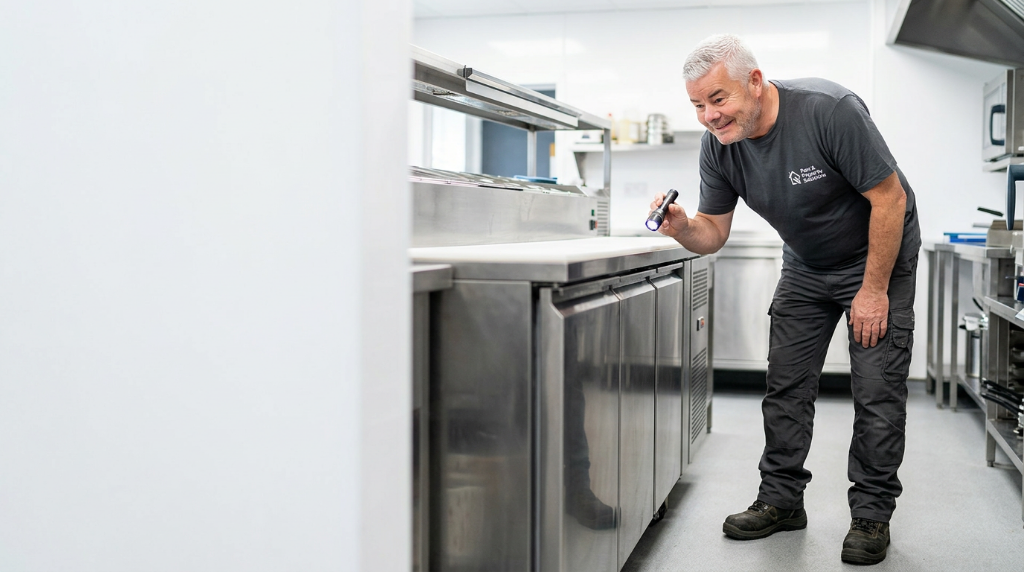
A professional commercial pest inspection covers far more than a quick look around. A qualified technician will assess your premises methodically and produce a written report that supports your compliance documentation.
A standard commercial pest inspection includes:
External Survey
- Inspection of the building perimeter for potential entry points
- Assessment of drainage, pipework, vegetation, and waste areas
- Identification of proofing requirements
Internal Survey
- Inspection of all food storage, preparation, and service areas
- Check of voids, roof spaces, cellars, and service areas where accessible
- Review of existing bait station placements and condition
- Identification of harbourage points and hygiene issues
Documentation Review
- Review of existing pest control records
- Assessment of gap between scheduled visits and current pest pressure
- Recommendations for frequency or additional treatment if required
Written Report
- Dated technician report with findings, recommendations, and any treatments carried out
- Bait station and monitoring device records
- Proofing action list for the business to address
Commercial Pest Control Compliance Checklist
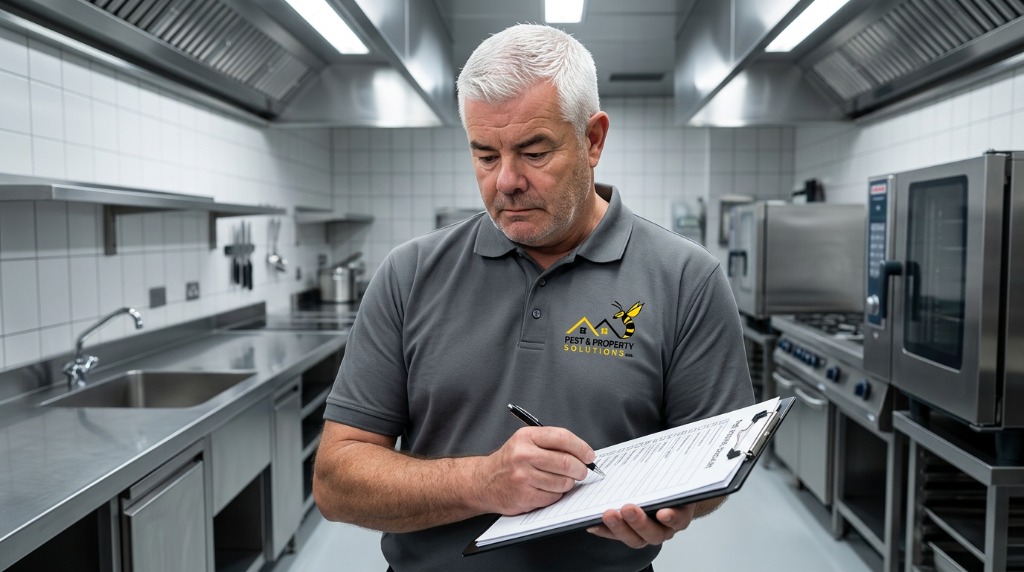
Use this checklist to assess your current compliance position. This covers the core requirements for most commercial and food business premises.
Documentation
- Signed pest control service contract with a licensed provider
- Schedule of visits agreed and in place (frequency appropriate to risk level)
- All technician visit reports filed and accessible
- Site plan or map showing bait station locations
- Pest sighting log maintained by staff
- Proofing works action list with completion dates
- HACCP documentation includes pest management controls
- Staff pest awareness training recorded
Physical Controls
- All external entry points sealed or proofed
- Door brushes, screens, and bristle strips fitted where required
- Drains in good condition with no gaps or damage
- Waste storage areas clean, lidded, and regularly emptied
- No harbourage points immediately outside the building (clutter, debris, vegetation)
- Bait stations in place, secured, and checked regularly
- Internal bait stations (where used) are tamper-resistant and clearly mapped
Monitoring and Response
- Staff know how to identify signs of pest activity
- Clear procedure in place for reporting pest sightings immediately
- Pest control provider contactable for emergency call-outs
- Corrective action is documented and evidenced
- Records updated after every visit and every action taken
Audit Readiness
- All records organised and accessible for inspectors
- Pest control file includes minimum two years of documentation
- No outstanding proofing or treatment recommendations left unaddressed
- Management sign-off on pest control procedures is in place
What Auditors and Environmental Health Officers Look For
When a Cardiff Council environmental health officer or a third-party food safety auditor visits your premises, pest control is one of the first things they check. They are looking for evidence that you have a system in place, that it is working, and that you are actively managing it.
Common findings that result in non-conformances or enforcement action include:
- No written contract with a pest control company
- Gaps in visit records (missed scheduled inspections)
- Unanswered recommendations from previous technician reports
- Evidence of pest activity with no recorded response
- Bait stations that are not logged, mapped, or maintained
- Staff who cannot describe the pest reporting procedure
- HACCP documentation that makes no reference to pest control
Getting ahead of these findings before an inspection is always the better approach. A proactive pest management programme, supported by good record keeping, makes the compliance process straightforward.
Food Hygiene Ratings and Pest Control in Cardiff
Cardiff businesses subject to the Food Hygiene Rating Scheme are scored across three categories: food hygiene and safety, the structure and cleanliness of the premises, and the confidence in management. Pest control directly affects all three.
Evidence of pest activity, poor proofing, or inadequate documentation can drag your rating down significantly. A rating below 3 (broadly compliant) triggers follow-up visits and can require you to display the score prominently on your premises.
How Often Should Commercial Premises Be Inspected?
There is no single legal answer to this, but there are widely accepted standards based on risk level.
Your pest control provider should carry out a risk assessment and recommend an appropriate visit frequency based on your premises type, location, food handling activities, and historical pest activity.
Frequently Asked Questions
What is commercial pest control compliance?
Commercial pest control compliance means meeting the legal and regulatory requirements for managing pest risks in a business setting. In the UK, this is primarily governed by the Food Safety Act 1990, the Health and Safety at Work Act 1974, and food hygiene regulations derived from EU Regulation 852/2004. Businesses must have documented pest management procedures, regular professional inspections, and evidence of corrective action when pests are found.
Is pest control a legal requirement for businesses?
Yes. UK law requires businesses, particularly those handling food, to take effective measures to prevent and control pests. Local authorities can take enforcement action against businesses that fail to do so, including issuing improvement notices, closing premises, and prosecuting under food safety legislation.
What does HACCP require for pest control?
Under HACCP (Hazard Analysis and Critical Control Points), food businesses must identify pest activity as a potential hazard, implement preventative control measures, monitor those measures, keep records, and take prompt corrective action if pests are detected. Pest control must be documented within the HACCP plan and supported by professional technician reports.
How often should a commercial property be inspected for pests?
High-risk food businesses should typically be inspected monthly or every six to eight weeks. Medium-risk commercial premises are generally inspected quarterly. The right frequency depends on the type of business, the food handling activities carried out, and any previous pest history. Your pest control provider can advise on the appropriate schedule.
What records do I need to keep for pest control compliance?
You should maintain a signed service contract, dated technician visit reports, a bait station map, a pest sighting log, proofing action records, and staff training records. Most auditors and environmental health officers expect to see at least two years of records.
What happens if pests are found during an environmental health inspection?
If an environmental health officer finds evidence of pest activity during an inspection, they will assess how well your business has responded. If you have a documented pest management system and can show prompt corrective action, the impact will be much reduced. If there are no records and no evidence of pest management, you may receive an improvement notice, a low food hygiene rating, or in serious cases, an emergency prohibition order closing your premises.
Can I manage pest control in-house to save money?
Some basic preventative measures can be managed internally. However, for the purposes of regulatory compliance, most environmental health officers and auditors expect to see evidence of a professional pest control service provided by a licensed company. In-house-only pest management is rarely sufficient to meet audit requirements.
Do warehouses need pest control compliance documentation?
Yes. Warehouses, particularly those handling food or goods for retail, are subject to local authority inspections and client audits that include pest control requirements. A documented pest management programme with visit logs, baiting station maps, and catch records is expected.
Book a Commercial Pest Inspection in Cardiff
If your business is due a pest inspection, your documentation needs updating, or you want to make sure you are fully compliant before your next environmental health visit, we can help. We work with restaurants, food manufacturers, warehouses, hotels, and commercial premises across Cardiff and South Wales.
What you get when you book with us:
- A full site survey of your premises, internal and external
- A written inspection report with findings and recommendations
- A bait station map and monitoring device log
- Advice on proofing and hygiene improvements
- An ongoing service schedule tailored to your risk level
- Support with HACCP pest control documentation
![[Professional headshot of Gareth Davies, branded uniform, plain or on-site background]](https://media.base44.com/images/public/6a030ac59700caa462b5b7c5/a28541072_gareth-caricature-rat-rifle-solid-black-bg.png)
Written by
Gareth Davies
Owner of Pest & Property Solutions
Gareth owns and runs Pest & Property Solutions. He sets the service standards, leads on inspections and complex jobs, and makes sure every customer gets practical, honest advice.
Expertise: Rodent control, Commercial pest control, Drain surveys and RatGate systems, Property inspections, Prevention and proofing
View full profile