Quick answer
Bird proofing means physically stopping birds landing, roosting or nesting on a building, using spikes, sprung wire, netting or mesh fitted to the spots they favour. It needs no licence because it harms no birds, but it must never block an active nest. In Wales, the best time to fit it is September to March, outside the gull breeding season.
Introduction
You notice it first on the front step: a fresh streak of droppings every morning, then a gutter that overflows in light rain, then the scratching and cooing under the solar panels at first light. Or you manage a block of flats on the coast and the spring complaints have already started about gulls diving at residents by the bins.
Both problems have the same answer, and it is a calm one. Birds use a building because it gives them somewhere sheltered to land, roost or nest close to food. Take away the landing spots and the shelter, deal properly with the mess they have left, and most of them move on without a single bird being harmed.
This guide covers the whole job for South Wales properties: which birds cause the problems, what Welsh law allows, which proofing suits which part of a building, how to clean up safely, when to do it and when to bring in a professional.
What is bird proofing, and how is it different from bird control?
Bird proofing is the physical part of bird control: products fixed to a building that stop birds landing, perching, roosting or nesting where they cause harm. Bird control is the wider term, and it can include scaring, habitat changes and, as a last resort under licence, lethal measures.
The distinction matters because proofing is lawful without any licence, as long as it does not injure birds or block access to an active nest. Natural Resources Wales (NRW) lists exclusion, including bird-proofing buildings, particularly ledges and roofs, as a recommended non-lethal method for feral pigeons, herring gulls and lesser black-backed gulls (NRW: alternatives to lethal control).
In practice, proofing is the part of the job that lasts. Scaring devices wear off as birds get used to them; a correctly fitted net or wire system keeps working for as long as it is maintained.
Which birds cause problems on South Wales buildings?
Three groups account for most of the bird problems on homes and commercial buildings across the region. NRW names the same species when it lists the public health and safety problems wild birds can cause, from droppings that create slip hazards to nests that block drains, gutters and ventilation.
| Bird | Where it causes problems | Typical problems | When it nests |
|---|---|---|---|
| Feral pigeon | Ledges, window sills, under solar panels, roof valleys, railway and shop canopies | Fouling, blocked gutters, noise, nesting under panels | Can nest throughout the year (RSPB) |
| Herring gull and lesser black-backed gull | Flat roofs, chimney stacks, parapets, coastal and town-centre rooftops | Nesting on roofs, noise, defensive diving in the breeding season, scattered rubbish, blocked gutters | Spring and summer; NRW treats September to March as outside the breeding season |
| Starling | Eaves, roof spaces, trees near buildings | Fouling below roosts, noise | Spring and summer |
Two points are worth knowing before any work is planned. First, herring gulls are a Red-listed species: roof-nesting numbers in towns can look high, but the RSPB reports that the overall herring gull population is falling sharply (RSPB: gulls nesting on your roof). Second, pigeons do not keep to a season, so a pigeon problem can be tackled at any time of year once you have checked there is no active nest in the area being proofed.
What does the law allow in Wales?
All wild birds in Wales are protected, including the common ones. Section 1 of the Wildlife and Countryside Act 1981 makes it an offence to intentionally kill, injure or take any wild bird, or to take, damage or destroy "the nest of any wild bird while that nest is in use or being built", or to take or destroy an egg (legislation.gov.uk, section 1).
What that means on a real roof:
- Proofing is lawful when it is fitted to areas with no active nest and the products do not injure birds. NRW advises that spikes should be blunt, because causing injury may itself be an offence, and that netting must be the correct gauge, correctly installed and regularly inspected to avoid entanglement.
- Blocking a bird in, or out, of an active nest is not. The RSPB is clear that it is illegal to prevent birds from accessing their nest. That is why nobody should net over a roof void or a solar array while birds are nesting inside it.
- Removing nests or eggs, or any lethal action, needs a licence. In Wales those licences come from NRW, which publishes its general licences each calendar year (NRW general licences for birds 2026). England's are issued separately, so rules read on an English website may not apply here.
- Nuisance alone is not a reason. The RSPB notes that simple nuisance or minor damage to property are not legally sanctioned reasons to kill gulls or remove active nests. NRW expects non-lethal measures to come first.
- Bats change everything. If there is any sign of bats in a roof space, work stops. Bats and their roosts are protected under the Conservation of Habitats and Species Regulations 2017 (legislation.gov.uk), and advice must be taken before anything is disturbed.
NRW's own guidance on gulls sets out the order to follow: prevention measures first, then non-lethal alternatives, and only then a licence application with supporting evidence (NRW gull management guidance note). Good proofing is the first and most effective of those steps.
The Proof, Deter, Clean framework
1. Proof: take away access. Close off the sheltered spaces birds use to nest and roost: the gap under a solar array, a roof void behind a broken soffit, a plant area on a flat roof, the inside of a chimney stack. Netting and mesh are the usual tools here, fitted only once any nest in that space is confirmed inactive.
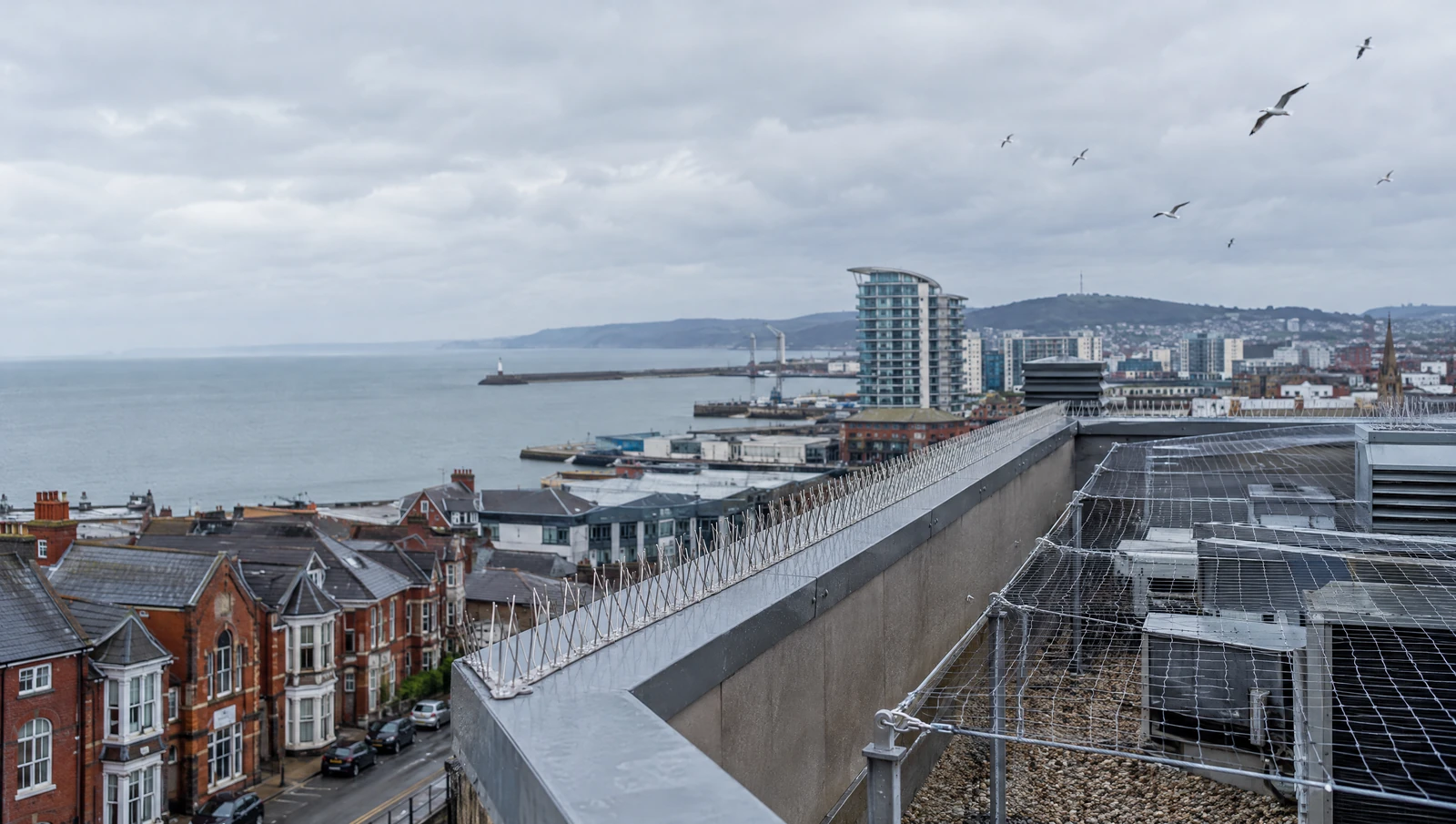
2. Deter: take away the landing spots. Ledges, parapets, ridge lines and sills are where birds sit, watch and foul. Spikes and sprung post-and-wire systems stop them settling without harming them.
3. Clean: take away the evidence. Droppings, feathers and old nest material are a health risk, block gutters and outlets, and signal to other birds that a site is safe. They are cleared, bagged and the area treated.
Which bird proofing method suits which part of the building?
There is no single product that works everywhere. The right choice depends on the species, the surface and how the birds are using it.
A few notes on each method:
- Spikes are best on narrow ledges where pigeons perch. They should be blunt-tipped and fixed so birds cannot nest in between them. They are a deterrent for landing, not a barrier to a void.
- Sprung post-and-wire runs low tensioned lines along a surface so birds cannot get a stable footing. It is discreet on heritage frontages and works well on wide parapets where gulls stand.
- Netting is the strongest option where birds are getting into a space: lightwells, courtyards, plant decks and loading bays. It has to be the right gauge for the species, tensioned properly and inspected, or it can trap birds.
- Solar panel mesh closes the gap between the array and the roof without drilling into the panels. Spikes cannot close that gap; mesh can. Our full explainer is here: pigeons under solar panels.
Myth vs reality: plastic owls and shiny tape. Visual scarers do work, for a while. NRW's guidance notes that most visual deterrents are subject to habituation, usually only working for a short period unless they are moved or changed often, and that fixed visual deterrents have an effective range of up to about 200 metres. For a building that birds have already chosen, physical proofing is the long-term answer.
Does bird proofing harm the birds?
Correctly specified and fitted, no. Proofing works by making a building less attractive, so the birds use somewhere else. The welfare risks come from poor work: sharp spikes, the wrong gauge of netting, slack nets that birds can get under, or proofing fitted over an active nest. Those are also the things that can turn a lawful job into an offence.
Two habits keep proofing humane: survey for active nests before anything is closed off, and inspect netting after installation and at regular intervals afterwards. A net with a hole in it is worse than no net, because a bird that gets in may not get out.
How do you clean up bird droppings safely?
Treat large build-ups of droppings as a health risk, not just a mess. The Health and Safety Executive warns that breathing dust or water droplets containing contaminated bird droppings can lead to diseases including psittacosis, a rare infection that affects pigeons among other birds, with flu-like symptoms and pneumonia usually appearing 5 to 19 days after exposure, and salmonella (HSE: diseases from bird droppings).
The HSE's controls for this work are a useful benchmark for anyone:
- Keep dust down. Wet the area before you start; never dry-brush heavy fouling.
- Never use a pressure washer on droppings. HSE says it creates contaminated airborne droplets.
- Wear the right protection. Gloves, waterproof footwear and protective clothing, plus respiratory protection with an assigned protection factor of 20 (an FFP3 disposable mask or a half mask with a P3 filter) where dust or spray could be created.
- Contain it. Plastic sheeting stops contamination spreading; wash hands thoroughly and eat and drink away from the work area.
- Know who should not do it. HSE advises that people with a weakened immune system should not directly handle tasks involving droppings.
A few fresh marks on a doorstep are a household cleaning job. A fouled roof space, a lightwell, a plant deck or anything at height is a job for a trained team with the right equipment, followed by professional disinfection.
When is the best time to bird proof in South Wales?
The best time is now, through autumn and winter. NRW's gull guidance recommends physically preventing nesting "any time outside of breeding season (September to March)", and clearing old nesting material in March before the birds return. Proofing fitted in October to February is in place before gulls start prospecting for nest sites in spring, which avoids any risk of closing off an active nest.
Pigeons are the exception. The RSPB notes that pigeons can nest throughout the year, so pigeon proofing is planned around a pre-work check for active nests rather than around the calendar.
For the full year at a glance, see our South Wales seasonal pest calendar.
What are the warning signs that a building needs bird proofing?
Look for any of these:
- Droppings building up on sills, steps, car parks or below a particular ledge
- Gutters or downpipes overflowing in light rain, often with nest material or feathers in them
- Cooing, scratching or flapping under solar panels or in a roof space, especially at first light
- Birds regularly perching on the same ridge, parapet or chimney
- Twigs, feathers or debris collecting on a flat roof or in roof valleys
- Gulls returning to the same roof each spring, or behaving defensively near bins and doorways
- Staining on render or stonework below ledges
One sign on its own may be nothing. Two or three together usually mean birds have adopted the building, and the problem grows each season they are left there.
What affects the cost of bird proofing?
The same product can be a quick job on one property and a much bigger one on another. These are the factors that move the price:
| Cost driver | Why it matters |
|---|---|
| Access | A ground-floor sill is simple; a three-storey parapet or a steep slate roof may need access equipment. |
| Area and length | Metres of ledge, the size of a netted area or the perimeter of a solar array. |
| Method and materials | Spikes, wire, netting and mesh involve different materials and fitting time. |
| Level of fouling | Heavy fouling means a longer clean-down. |
| Nesting status | An active nest in the area can mean waiting, phasing the work, or needing licensed advice before anything is closed off. |
| Building type | Heritage frontages, commercial roofs and occupied blocks may need discreet products, out-of-hours working or permits. |
The cheapest option is rarely the cheapest outcome. Spikes on a ledge where the real problem is a void behind the soffit, or a net with no clean-down underneath, usually mean paying twice. Ask for a fixed quote that names the method for each area.
Homes, blocks and commercial premises: what changes?
Homeowners. The typical South Wales terrace, with its slate roof, chimney stacks and rear extension, gives pigeons and gulls plenty of sheltered ledges in a small space.
Block managers and landlords. Communal roofs, balconies and bin stores generate repeat complaints from residents, and blocked gutters lead to damp.
Commercial and food premises. Droppings at entrances are a slip hazard and, near food, a hygiene risk that inspectors notice. Loading bays, canopies and plant areas are the usual focus. Our guide to commercial pest control compliance covers the wider record-keeping picture, and our commercial pest control page sets out how we work with businesses.
What can you do yourself?
Plenty, as long as it is safe and at ground level. This checklist makes a building less attractive to birds without any special equipment:
- Keep bins lidded and emptied; NRW notes that food waste and unprotected bins can make gull problems worse.
- Do not feed pigeons or gulls near the building, and ask neighbours and tenants not to.
- Clear gutters you can reach safely from the ground, outside the nesting season.
- Clear old, unused nest material in March before the birds return, only where you are certain the nest is no longer in use.
- Note where droppings collect each week; it tells you exactly where birds are landing.
- Check solar panels from the ground for debris or birds going in and out of the gap.
DIY stops at height and at active nests. Working on roofs, parapets and chimneys is dangerous without the right access equipment, and closing off a space with a nest in it can be an offence.
When should you call a professional?
Call a professional when any of these apply:
- The problem areas are above ground level: roofs, parapets, chimney stacks, solar arrays or upper-floor ledges.
- Birds are nesting under solar panels or in a roof space.
- There is a heavy build-up of droppings, particularly in an enclosed space or near food.
- Gulls are behaving defensively towards residents, staff or customers.
- You manage a block, a commercial building or food premises and need records of what was done.
- You are not sure whether a nest is active, or whether bats could be present.
A professional survey identifies the species, how they are using the building and whether any nest is active, then sets out Proof, Deter, Clean for each area so the work is lawful and lasts.
Key takeaways
- Bird proofing physically stops birds landing, roosting and nesting; it needs no licence, but it must never injure birds or block an active nest.
- All wild birds in Wales are protected under the Wildlife and Countryside Act 1981; removing nests, eggs or birds needs an NRW licence and non-lethal measures come first.
- Match the method to the area: spikes and wire for ledges and parapets, netting for spaces, mesh for solar arrays.
- Proof between September and March for gulls; pigeons can nest all year, so check for active nests first.
Frequently asked questions
Is bird proofing legal in Wales?
Yes. Bird proofing is legal in Wales without a licence, provided it does not injure birds and is not fitted over an active nest or used to stop birds reaching one. All wild birds are protected under the Wildlife and Countryside Act 1981, so removing nests or eggs, or any lethal control, needs a licence from Natural Resources Wales.
When is the best time of year to bird proof a roof?
For gulls, the best time is between September and March, which Natural Resources Wales treats as outside the breeding season. Fitting proofing in autumn or winter means it is in place before gulls look for nest sites in spring. Pigeons can nest all year, so pigeon work starts with a check for active nests.
What is the best bird proofing for solar panels?
Mesh clipped around the edge of the array is the standard approach. It closes the gap between the panels and the roof so pigeons cannot nest underneath, without drilling into the panels. Spikes do not work for this because the problem is access to the space beneath, not perching on top.
How do I stop gulls nesting on my roof?
Proof the places gulls nest before the breeding season starts: flat roofs, chimney stacks, valleys and parapets, using netting, wire or spikes depending on the surface. Keep bins lidded and stop any feeding nearby. Once a nest is being built, it is protected, and removing it needs a licence from Natural Resources Wales.
Are bird droppings dangerous to clean up?
They can be. The HSE warns that breathing dust or droplets from contaminated droppings can cause diseases including psittacosis and salmonella. Small, fresh marks can be washed away with gloves on. Heavy build-ups need wetting down, no pressure washer, FFP3-level respiratory protection, and are best handled by a trained team.
Protect your building before spring
Bird problems get bigger every season they are left, and the window to proof for gulls closes in March.
Get a bird proofing quote or see our bird control service, pigeon proofing and solar panel bird proofing. We cover Swansea, Cardiff and the surrounding areas: see pest control in Swansea and pest control in Cardiff.
About the author
Gareth Davies is the owner of Pest & Property Solutions and a member of the British Pest Control Association (BPCA). Meet the team.
Written by
Gareth Davies
Owner of Pest & Property Solutions
Gareth owns and runs Pest & Property Solutions. He sets the service standards, leads on inspections and complex jobs, and makes sure every customer gets practical, honest advice.
Expertise: Rodent control, Commercial pest control, Drain surveys and RatGate systems, Property inspections, Prevention and proofing
View full profile