
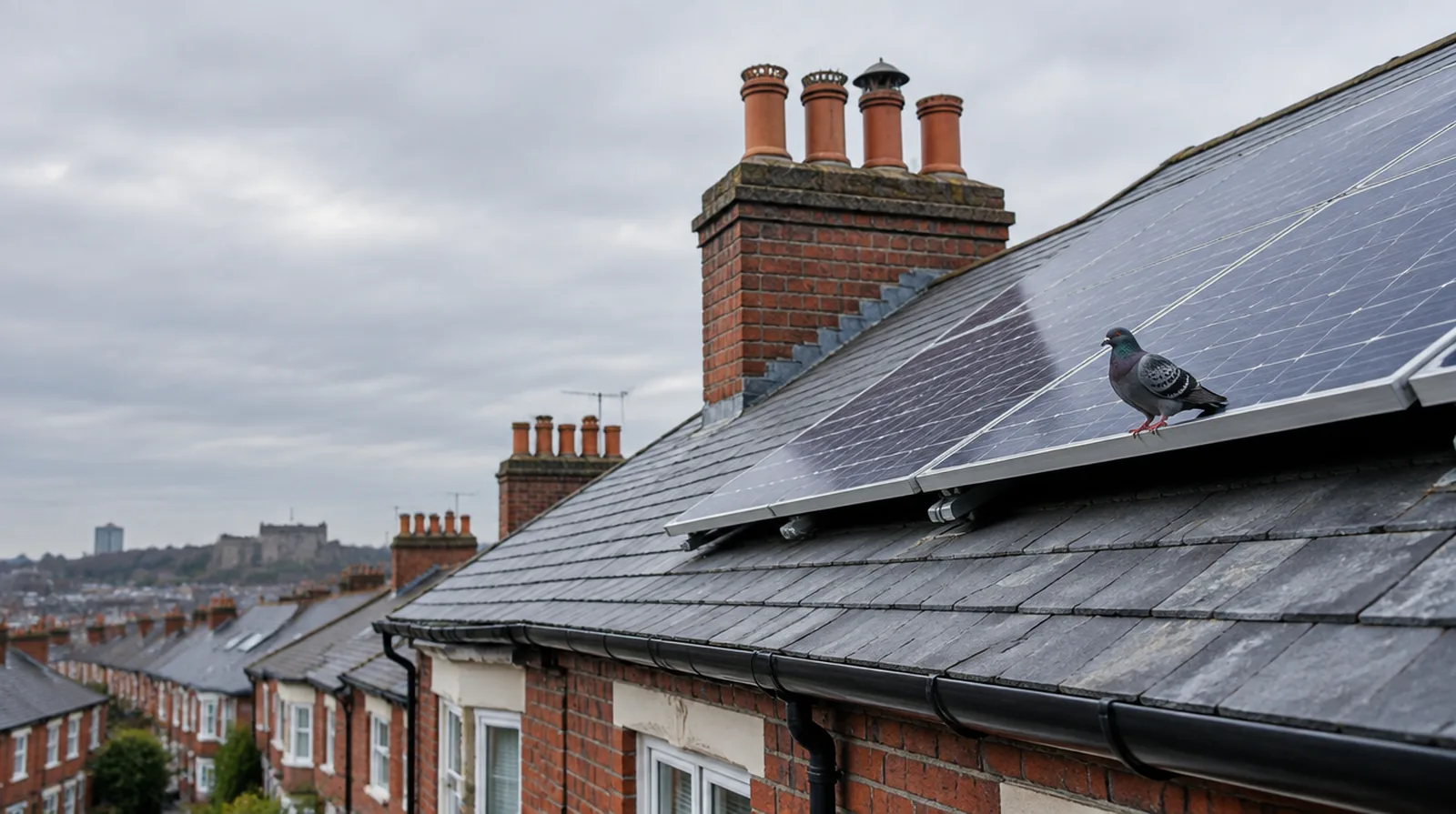
Pigeons nest under solar panels because the gap between the array and the roof is dry, warm and sheltered from wind and predators. The fouling damages tiles, blocks gutters and reduces panel output. The fix is mesh clipped around the edge of the array, not spikes, and it is fitted without drilling into the panels, the rails or the roof.
The first sign is usually the noise. Cooing and scraping above the bedroom at dawn, then a scatter of droppings on the panels, the conservatory roof or the patio below. By the time you spot nesting material poking out from under the array, a pair has often been in residence for weeks.
Birds nesting under solar panels is one of the fastest-growing roof problems we deal with across pest control in Cardiff and South Wales, and the story is nearly always the same. Panels went on a south-facing pitch, nobody proofed the gap underneath, and the local pigeons found the best-sheltered site on the street.
This guide explains why it happens, what the fouling is doing to your roof and your panels, what proofing actually involves, and where the law sits in Wales. It has been reviewed by Sion Jenkins, our Cardiff technician, who specialises in solar panel bird proofing.
Why are there pigeons under my solar panels?
Because the array creates exactly the nesting site a feral pigeon is looking for. A solar panel sits on rails above the tiles, which leaves a gap underneath. That gap is dry, out of the wind, warm from the panel above it, and hard for gulls, cats and people to reach. A pigeon that would otherwise nest on a ledge or in a broken soffit will choose it every time.
Pigeons pick the most sheltered spot they can find, so the first pair tends to settle under the corner of the array that is most out of the weather. Once that pair is established and raising young, more pigeons follow, and a single array can end up home to several nests.
Feral pigeons breed for most of the year when the site is warm enough, so a gap found in October is not an empty gap in January. Autumn is when the problem starts, not when it pauses, as our South Wales seasonal pest calendar shows.
What does the gap under a solar array look like?
A typical rooftop array sits a hand's width or so above the roof, depending on the mounting rails and the roof covering. On a slate roof, which covers most of Cardiff's Victorian and Edwardian terraces, the gap can be larger because the rails have to clear the slate hooks and the lap.
That height matters for two reasons. It is plenty for a pigeon to walk in upright, and it is too tight for most people to get a hand into to clear anything out. Which is why nests under panels get left, and why the mess underneath builds up unseen.
| What the array offers | Why it matters to a pigeon |
|---|---|
| Shelter from rain and wind | The panel is a roof over the nest. Ledges, chimney stacks and gutters are not. |
| Warmth | Panels warm in the sun and hold heat into the evening. The space beneath stays milder than the open roof. |
| Safety from predators | Gulls, crows and cats cannot easily reach under the array. Pigeons can see every threat coming from the panel edge. |
| A clear view | Pigeons like a vantage point. The top edge of the array gives them one. |
| Nobody disturbs it | Most owners never go on the roof. A nest under a panel can sit for a whole season unnoticed. |
What damage do pigeons under solar panels do?
The harm is cumulative and most of it is out of sight until something fails.
Fouling on the panels and the roof
Pigeon droppings are acidic. On the glass they reduce the light reaching the cells, so output falls, and because many inverter apps report the system as a whole you may not notice the drop. On slate and tile the droppings hold moisture against the surface and stain. Under the array the build-up sits on the roof covering with no rain to wash it away.
Blocked gutters and downpipes
Nesting material, feathers and droppings wash down into the gutter every time it rains. A blocked gutter on a terrace overflows against the party wall or down the rear elevation, and damp inside follows.
Damage to cabling and fittings
Pigeons will pull at anything loose. Cable ties, insulation on the DC cabling and edging strips are all fair game for nest material. A chewed or exposed cable under a live array is a fault waiting to happen, and it sits where nobody can see it.
Noise, smell and health
Cooing at dawn is often the first complaint. Behind it, a nest site that has been in use for months carries droppings and feathers. Breathing dust from dried bird droppings can cause illness, including psittacosis and salmonella, according to Health and Safety Executive guidance on bird droppings. That is a reason to have the fouling cleaned and treated properly before anything is fitted, not a reason to panic.
Does solar panel bird proofing damage the panels?
Not when it is done properly, and this is the question we are asked most. The proofing goes around the array, never through it. Nothing is screwed into the panels, the rails, the tiles or the membrane.
Our rule on every solar job is simple. If anyone wants to drill into your rails or stick anything to the glass, send them away. The mesh is held by clips on the edge of the panel frame, so the panels and your manufacturer warranty are left alone, and if a panel ever needs replacing the mesh can be taken off and refitted.
How does mesh-and-clip proofing work?
A proper solar panel bird proofing job runs in five steps, and the order is the point.
- 1
Survey. We assess the bird species, how far the nesting has gone, the panel layout, the state of the roof and gutter, and the access needed. Only then is a fixed quote written.
- 2
Clear and disinfect. Nests, droppings and debris are removed from under the array and the area is professionally disinfected. Fouling that is sealed in rather than removed stays as a smell and a health risk.
- 3
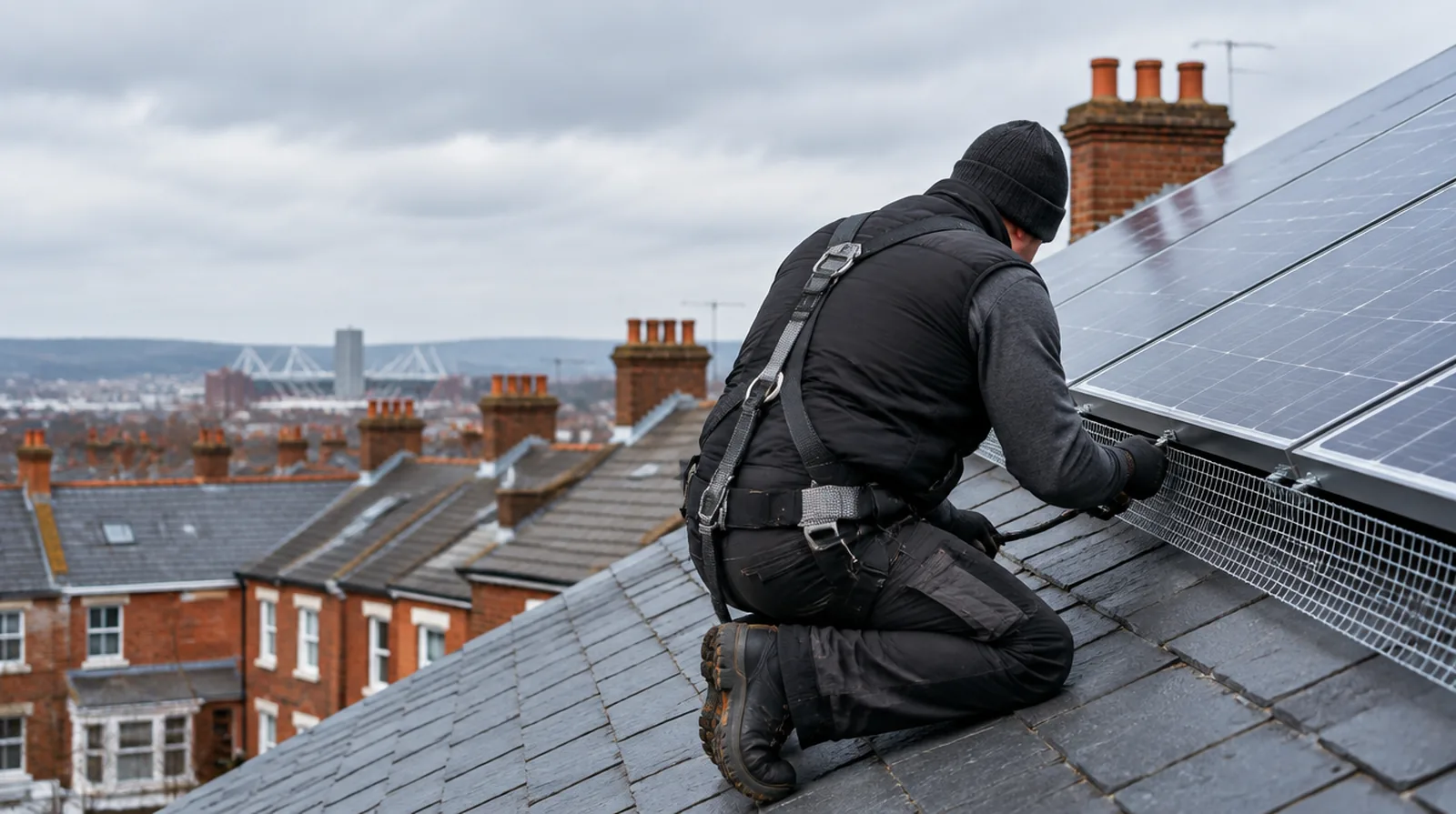
Mesh. Galvanised or stainless steel mesh is cut to follow the full perimeter of the array, closing the gap between the panel frame and the roof.
- 4
Clip. The mesh is held with specialist clips that grip the panel frame. No drilling through the panels, the tiles or the membrane, and no adhesive on the glass.
- 5
Check and sign off. Every edge is checked, the gutter is cleared, and you get a full photographic record of the installation with our 5-year guarantee.
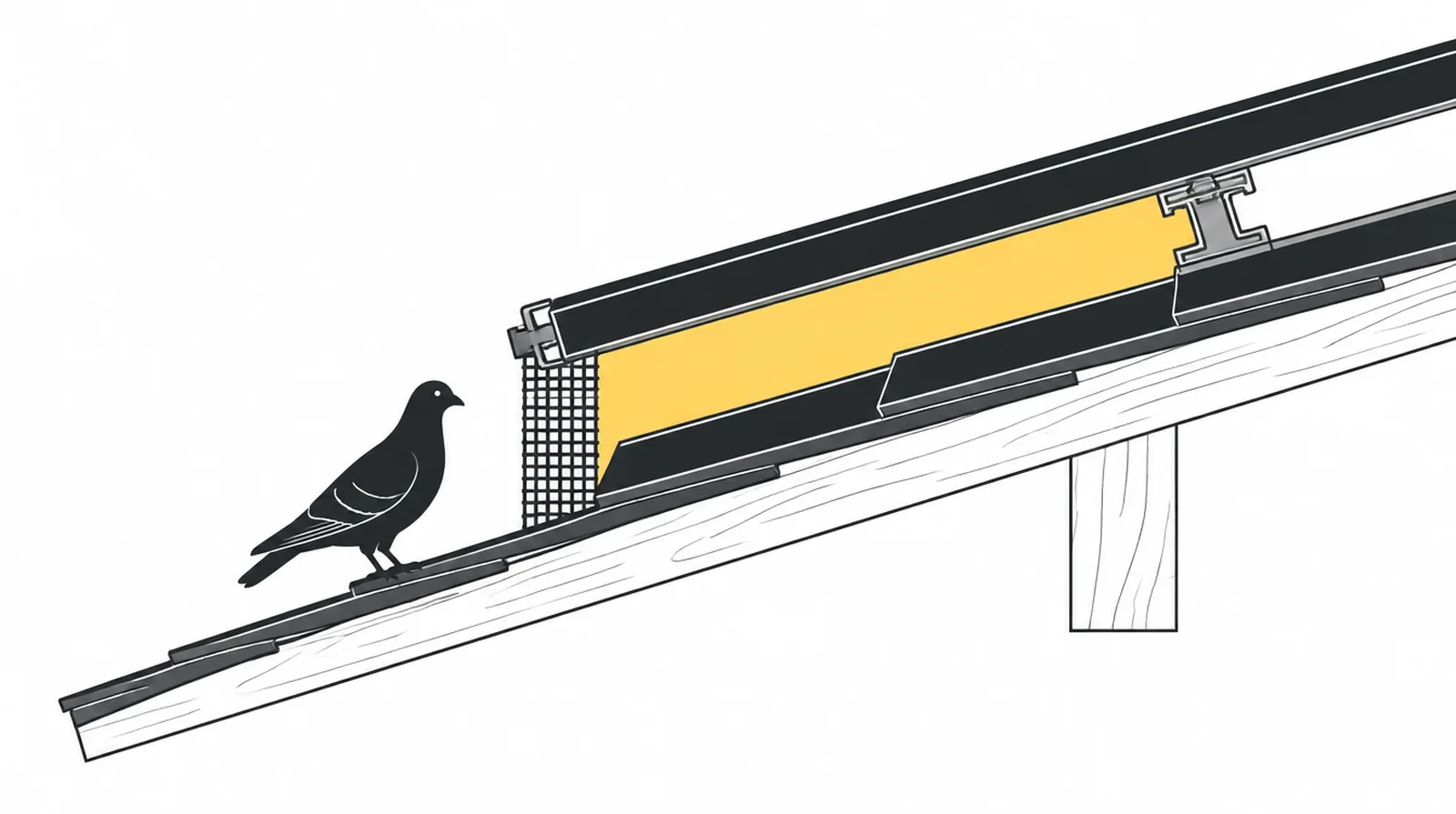
The mesh sits in the shadow line under the panels, so from the street it is discreet.
Why not just fit spikes?
Spikes are the wrong product for a solar array. Spikes stop a bird landing on a ledge. They do nothing about the gap underneath the panels, which is where the pigeons actually want to be. Fitted on or against the panels they can scratch the glass, damage the frame edge and put the manufacturer warranty at risk. The proofing has to close the gap, and a correctly specified mesh system is what does that. Spikes still have their place on ledges and parapets as part of wider pigeon proofing, just not on the array.
Myth: pigeons will give up and move on once the chicks have fledged.
Reality: a successful nest site gets reused. The same pair returns, and others follow them in. The gap stays attractive until it is closed.
Is it legal to proof solar panels against pigeons?
Yes. Proofing and deterrence are legal, and the feral pigeon is not a specially protected species. What the law protects is the bird, its active nest and its eggs: all wild birds are covered by the Wildlife and Countryside Act 1981, and in Wales the general licences that allow some control of feral pigeons are issued by Natural Resources Wales, not by the English authorities.
In practice that means two things. We survey before we proof, and if there is an active nest with eggs or chicks, the gap is not closed until the law allows it. Anyone offering to rip out an active nest on the spot is putting you at risk, not themselves. The licence wording changes from year to year, so it is checked before any bird job.
Warning signs that pigeons are already under your panels
- Cooing, scraping or flapping from the roof at first light.
- Droppings on the panel surface, the gutter line, the conservatory roof or the ground below the array.
- Feathers and twigs caught in the gutter or on the tiles below the panels.
- Pigeons perched along the top edge of the array for long periods.
- A fall in output on the inverter app with no obvious weather reason.
- A smell from the loft or the room directly below the array in warm weather.
Two of those together and it is worth a survey.
How to prevent pigeons nesting under solar panels
- Proof the array when the panels are installed, or as soon as possible afterwards. Closing an empty gap is a smaller job than clearing an occupied one.
- Keep bird food, fallen fruit and open bins away from the house. Pigeons nest near a reliable food supply.
- Keep the gutter clear so there is nothing for nest material to build on.
- Check the array edge from the ground each spring and autumn, or ask us to look while we are on the roof for anything else.
- Do not fit spikes, netting over the panels or anything stuck to the glass. It does not close the gap and it can damage the panels.
If you have read this far and recognised your own roof, a survey comes with a fixed quote and no obligation.
When to call a professional
Working on a pitched roof around live electrical equipment is not a DIY job, and we say that as a firm that is happy to tell people when a job is safe to do themselves. The panels carry DC voltage whenever there is daylight, the roof edge is where falls from height happen, and clearing an active nest without the right licence position is an offence. See our guide on when to call a professional, and call us when:
- You can see or hear pigeons under the array.
- There are droppings or nest material on or below the panels.
- A spike or netting job by someone else has failed or damaged the panels.
- You are having panels fitted and want the gap proofed at the same time.
Solar panel proofing is part of our wider bird control and proofing work across South Wales. We are NPTA accredited, every installation is photographed, and every solar job comes with our 5-year guarantee.
Key takeaways
- Pigeons nest under solar panels because the gap is dry, warm and sheltered. The first pair settles under the most sheltered corner and others follow.
- The damage is fouling on the glass and the roof, blocked gutters, stripped cabling and noise, most of it out of sight.
- Proofing is mesh clipped around the edge of the array. Nothing is drilled into the panels, the rails or the roof.
- Spikes do not close the gap and can damage the panels and put the warranty at risk.
- Proofing is legal; interfering with an active nest is regulated. Survey first, every time.
Frequently asked questions
Why are there pigeons under my solar panels?
The gap between the panels and the roof is dry, warm from the panel above and sheltered from wind and predators, which makes it the best nesting site on the street. Pigeons settle under the most sheltered corner first and more follow once a pair is established, so the problem grows each season.
Does pigeon proofing damage solar panels?
No, not when it is done properly. The mesh is held by clips on the panel frame around the edge of the array, and nothing is drilled, glued or screwed into the panels, the rails or the roof. The panels and the manufacturer warranty are left alone, and the mesh can be taken off and refitted if a panel ever needs replacing.
Can I fit spikes on my solar panels to stop pigeons?
Spikes are the wrong product for a solar array. They stop a bird landing on a ledge but do nothing about the gap underneath the panels, which is where pigeons nest. Fitted on or against the panels they can scratch the glass, damage the frame and put the warranty at risk. Mesh closes the gap.
Is it legal to remove pigeons from under solar panels?
Proofing and deterrence are legal. All wild birds, their active nests and eggs are protected under the Wildlife and Countryside Act 1981, and feral pigeon control in Wales runs under Natural Resources Wales general licences. We survey first and do not close the gap on an active nest until the law allows it.
How long does solar panel bird proofing take?
Most domestic arrays are surveyed, cleared, disinfected and meshed in a single visit, with the time depending on the size of the array, the roof pitch and how much fouling has to be cleared. You get a fixed quote after the survey, photographs of the finished job and a 5-year guarantee.
Hearing them at dawn?
Book a roof survey and get a fixed quote for mesh-and-clip proofing that never drills into your panels. Solar panel bird proofing across Cardiff, Newport, Swansea and South Wales.
Book a roof survey or call 02922 404605.
![[Professional headshot of Gareth Davies, branded uniform, plain or on-site background]](https://media.base44.com/images/public/6a030ac59700caa462b5b7c5/a28541072_gareth-caricature-rat-rifle-solid-black-bg.png)
Author
Gareth Davies
Owner of Pest & Property Solutions
Gareth owns and runs Pest & Property Solutions. He sets the service standards, leads on inspections and complex jobs, and makes sure every customer gets practical, honest advice.
Expertise: Rodent control, Commercial pest control, Drain surveys and RatGate systems, Property inspections, Prevention and proofing
View full profileReviewed by
Sion JenkinsSenior Technician, Cardiff. Solar Panel Bird Proofing Specialist
View reviewer profile