Quick answer
Loft cleaning after rats or mice means removing contaminated insulation, droppings and nesting material, disinfecting the joists and boards, and sealing the entry points so the problem cannot restart. It should only begin once treatment has finished. A professional clear-out uses protective equipment and damp methods to keep contaminated dust out of the air.
Introduction
The treatment worked. The scratching above the bedroom ceiling has gone quiet and the follow-up visit found no fresh activity. Then you open the loft hatch to fetch the Christmas decorations and the smell hits you, the insulation has flattened tracks running across it, and there are droppings along every joist.
This is the point most people do not plan for. Getting rid of rats or mice and getting rid of what they left behind are two separate jobs, and the second one is just as important for a healthy home.
This guide explains what a professional loft clean-up after rodents involves, step by step, how to tell whether your loft needs one, where it is safe to do some of it yourself, and where it is not.
Why is treating the rodents only half the job?
Because the contamination stays in the loft after the animals have gone. Rats and mice leave droppings, urine and nesting material wherever they travel, and loft insulation is a soft, deep material that holds all three.
There are two health reasons to take this seriously, both of them low in probability but worth respecting:
- Leptospirosis (Weil's disease). The NHS explains that leptospirosis is spread in the urine of infected animals, most commonly rats, mice, cows, pigs and dogs, and can enter the body through the mouth, eyes or a cut. (NHS 111 Wales)
- Hantavirus. UK Health Security Agency guidance describes infection through breathing in particles from rodent droppings or urine, or dust containing them. It rates the overall risk to the public from Seoul hantavirus, the type carried by rats, as very low. (UKHSA)
The practical lesson from both is the same: the risk comes from disturbing contaminated material carelessly, especially raising dust in a confined loft space. That is why the method matters as much as the clean itself.
There is also a property reason. Soiled, compressed insulation does not insulate well, and the Energy Saving Trust advises that insulation which has become compressed is best removed and replaced rather than topped up. (Energy Saving Trust)
What are the signs your loft needs a professional clean?
A few droppings on a boarded section near the hatch is one thing. Contamination worked into the insulation is another. There are three signs to look for in the insulation.
| Contamination sign | What it looks like | Why it matters |
|---|---|---|
| 1. Droppings through the insulation | Droppings mixed down into the insulation layer, not just sitting on top or along the joists | Surface cleaning cannot reach them; the insulation itself is contaminated |
| 2. Urine staining and smear marks | Yellow or dark staining in the insulation, greasy grey smear marks on joists and timbers, a sharp ammonia smell when the hatch opens | Urine soaks in and carries the leptospirosis risk; the smell lingers until the material is removed |
| 3. Runs, tunnels and nesting | Flattened tracks across the insulation, tunnels through it, shredded insulation or paper gathered into nests | Shows how far the rodents travelled, and that the insulation is now compressed and damaged |
If you can see any of the three from the hatch, the loft needs more than a sweep. If you can see all three, the affected insulation will almost certainly need to come out.
For help working out what was in the loft in the first place, see our guides to scratching noises in the loft at night and how to identify a rat infestation.
What does a professional loft clear-out involve?
A thorough clear-out follows four steps in order: treat, clear, disinfect, proof. Skipping or reordering any of them is how lofts end up contaminated twice.
Step 1: Treat (and confirm it has worked). Cleaning starts only when the rodent treatment has finished and follow-up checks show no fresh activity. Clearing a loft while rodents are still active simply gives them clean insulation to start again in. Any bait stations or monitoring points in the loft should be dealt with by the technician who placed them, never moved or emptied by anyone else.
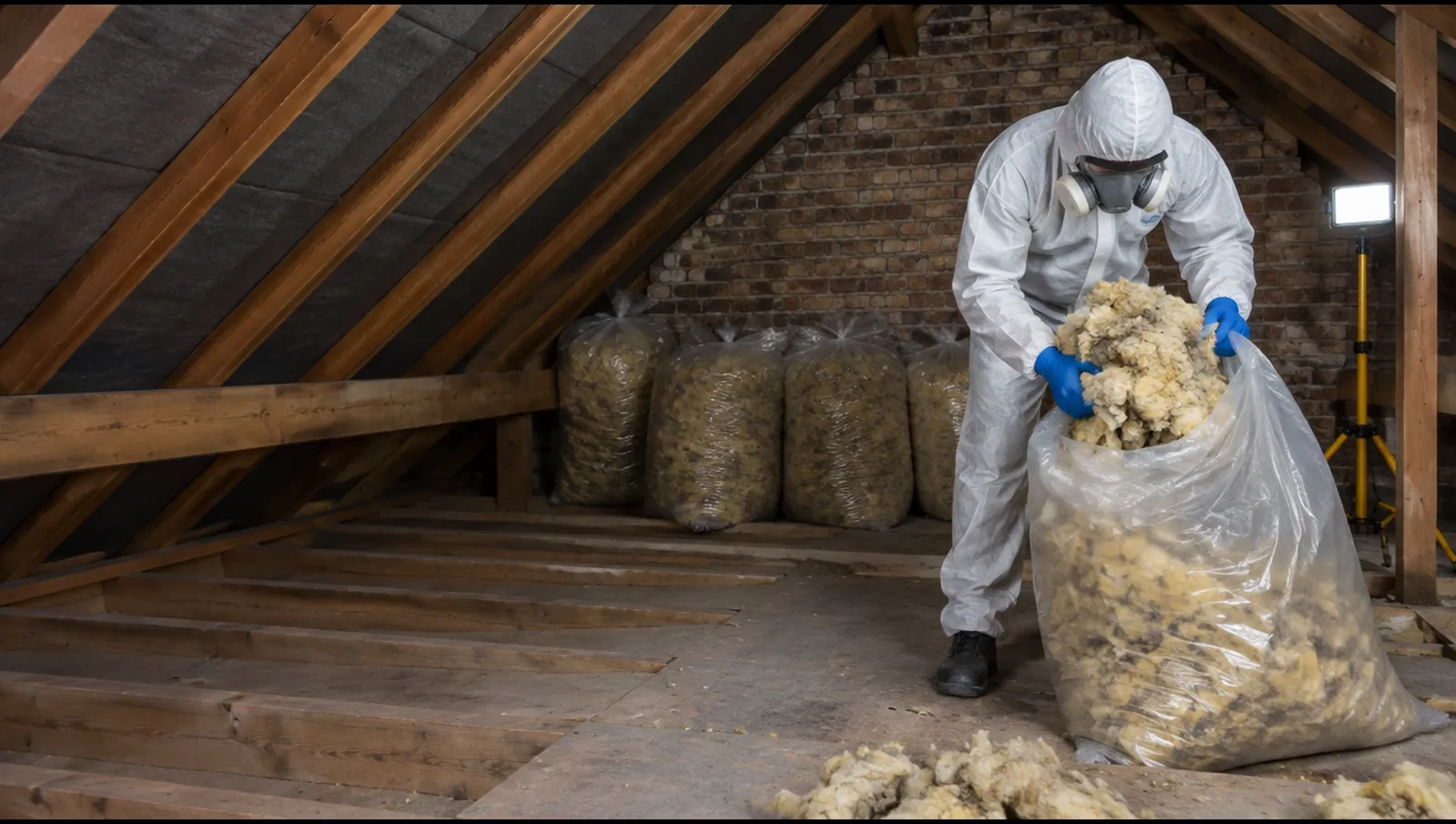
Step 2: Clear. The work is done in a disposable coverall, gloves and a respirator. Contaminated insulation is rolled or lifted carefully, not dragged, and bagged in heavy-duty sacks inside the loft before it comes down through the house. Droppings and nesting material are collected using damp methods. Dry sweeping and household vacuum cleaners are avoided because both throw fine dust into the air, which is exactly what UKHSA guidance warns against when it recommends a mop or damp cloth to limit airborne particles.
Step 3: Disinfect. Once the loft is clear, the joists, boards, the back of the ceiling and any stored items that are staying are treated with a suitable disinfectant. This deals with the urine and residue the insulation was sitting on. It is also the time to check for the three contamination signs again: a loft should only be called clean when none of them remain. Our disinfection services cover the same process in other parts of a property.
Step 4: Proof. Before fresh insulation goes down, the entry points are sealed. In a loft that usually means gaps at the eaves, holes around pipes and cables coming through the walls, and, in terraced houses, any gaps where the party wall stops short of the roof. Sealing them before the new insulation goes down protects the clean loft from day one.
The loft is then ready for new insulation. The Energy Saving Trust recommends a minimum depth of 270mm and warns against blocking the eaves vents, which keep the roof space ventilated and free of damp. (Energy Saving Trust)
| Step | What happens | What it prevents |
|---|---|---|
| Treat | Rodent activity stopped and confirmed by follow-up checks | Cleaning a loft that gets reinfested straight away |
| Clear | Contaminated insulation, droppings and nests removed using PPE and damp methods | Contaminated dust spreading through the loft and the house |
| Disinfect | Joists, boards and surfaces disinfected, contamination signs rechecked | Residue left under the new insulation |
| Proof | Eaves, pipe entries and party wall gaps sealed | Rodents returning to fresh, clean insulation |
Can you clean a loft after mice yourself?
Sometimes, for a small amount of surface mess. If you find a handful of droppings on a boarded area and nothing in the insulation, you can deal with it safely:
- Wear disposable gloves and cover any cuts with waterproof plasters, as the NHS advises.
- Dampen the droppings with a household disinfectant first, then wipe them up with paper towels. Do not sweep or vacuum them.
- Bag the waste, seal it and put it in your general waste bin.
- Wash your hands thoroughly afterwards.
DIY stops at any of the following points:
- The contamination is in the insulation. Removing it means hours of work in a confined space, disturbing exactly the material that carries the risk.
- Treatment is still running. Leave bait stations alone and let the technician finish the job first.
- You are not sure what the insulation is. The HSE warns that asbestos can be present in any building built or refurbished before 2000, and it releases fibres when disturbed. If the loft has loose, granular insulation or old pipe lagging, stop and get it checked before anyone touches it. (HSE)
- There may be bats. Bats and their roosts are protected. Natural Resources Wales advises contacting it before work such as fitting loft insulation that could disturb bats, and stopping work if you find one. (Natural Resources Wales)
- The loft is not boarded. Stepping between joists in poor light is how ceilings, and people, come through.
If any of those apply, our team can survey the loft and tell you exactly what needs to come out.
Terraced lofts and house sales
In some older terraces the party wall inside the loft does not run all the way up tight to the roof, so the roof spaces of neighbouring houses can connect through gaps along the top of the wall. Rodents can use those gaps as a corridor, which is why a clean-up in one house can be undone by activity next door unless the party wall gaps are proofed as part of the job.
The second pattern is the house sale. A buyer's surveyor goes into the loft, sees droppings in the insulation and flags it in the report. For a seller, a completed treatment followed by a professional clear-out, with the entry points proofed, is a clear answer to that question. If you are in or around Pontypridd, see our Pontypridd page for the areas we cover locally.
How do you keep a loft clean once it has been cleared?
A few simple checks every few months, and especially as the weather turns in autumn, will catch any return early:
- Open the hatch and listen for a minute in the evening, when rodents are most active.
- Look along the first few joists from the hatch for fresh droppings or new tracks in the insulation.
- Check that boxes stored in the loft are sealed plastic, not cardboard, which rodents shred for nesting.
- Walk round the outside of the house: look for gaps at the eaves, damaged airbricks and holes around pipes.
- Keep the eaves vents clear so the loft stays dry; damp, soft insulation is more attractive nesting material.
When should you call a professional?
Call us if any of the three contamination signs are visible in the insulation, if you can smell the loft from the landing, if the rodent treatment has not yet been confirmed as finished, or if you are selling and the survey has flagged the loft. A survey tells you how much insulation needs to come out, which entry points need proofing, and what the job involves before any work starts. For urgent situations, our guide to when to call a professional sets out what counts as an emergency.
Key takeaways
- Treating rats or mice and cleaning the loft are separate jobs; contamination stays in the insulation after the rodents have gone.
- Check insulation for three signs: droppings through it, urine staining and smears, and runs, tunnels or nests.
- A thorough clear-out follows four steps in order: treat, clear, disinfect, proof.
- Never sweep or vacuum rodent droppings; damp methods keep contaminated dust out of the air.
- Stop and get advice if the insulation could contain asbestos or if bats may be present.
Frequently asked questions
Is it dangerous to have rat droppings in my loft insulation?
The risk is low but real. Rat and mouse droppings and urine can carry leptospirosis and hantavirus, and the main danger comes from disturbing the material and breathing in contaminated dust, or touching your mouth, eyes or a cut afterwards. Left undisturbed the risk is small; cleared carelessly it rises, which is why method matters.
Do I need to replace loft insulation after mice?
If droppings, urine staining or tunnels have worked into the insulation, yes. Contaminated insulation cannot be cleaned in place, and compressed insulation no longer performs well. If the mess is limited to a boarded area or the surface near the hatch, the insulation may be fine once the surfaces have been disinfected and the entry points sealed.
Can I just vacuum up mouse droppings in the loft?
No. A household vacuum cleaner and a dry brush both lift fine dust into the air, and that dust is how hantavirus is breathed in. Dampen the droppings with disinfectant, wipe them up with paper towels while wearing gloves, bag the waste and wash your hands. Anything beyond a small area is a job for a professional.
How do I know the rats have gone before I clean the loft?
The best evidence is a follow-up visit from the technician who treated the problem, confirming no fresh droppings, no new tracks and no activity at the monitoring points. At home, listen at night over several evenings and check for fresh, soft droppings. Clearing the loft before treatment has finished risks starting again.
How long does a professional loft clean take?
It depends on the size of the loft, how much insulation is contaminated, access through the hatch and how much proofing is needed. A lightly affected loft can be a short job; a heavily contaminated one takes longer. We confirm the timescale after a survey, before any work is booked, so you know what to expect.
Book a loft survey
If your loft still shows signs of rats or mice after treatment, our local team will survey it, explain what needs to come out and give you a fixed quote for the clear-out and proofing. Book a loft clean-up survey, call 02922 404605, or get a free quote.
About the author
Gareth Davies is the owner of Pest & Property Solutions and a BPCA member. He sets the service standards for the team and leads inspections and complex jobs across Cardiff and South Wales.
Written by
Gareth Davies
Owner of Pest & Property Solutions
Gareth owns and runs Pest & Property Solutions. He sets the service standards, leads on inspections and complex jobs, and makes sure every customer gets practical, honest advice.
Expertise: Rodent control, Commercial pest control, Drain surveys and RatGate systems, Property inspections, Prevention and proofing
View full profile