
Quick answer
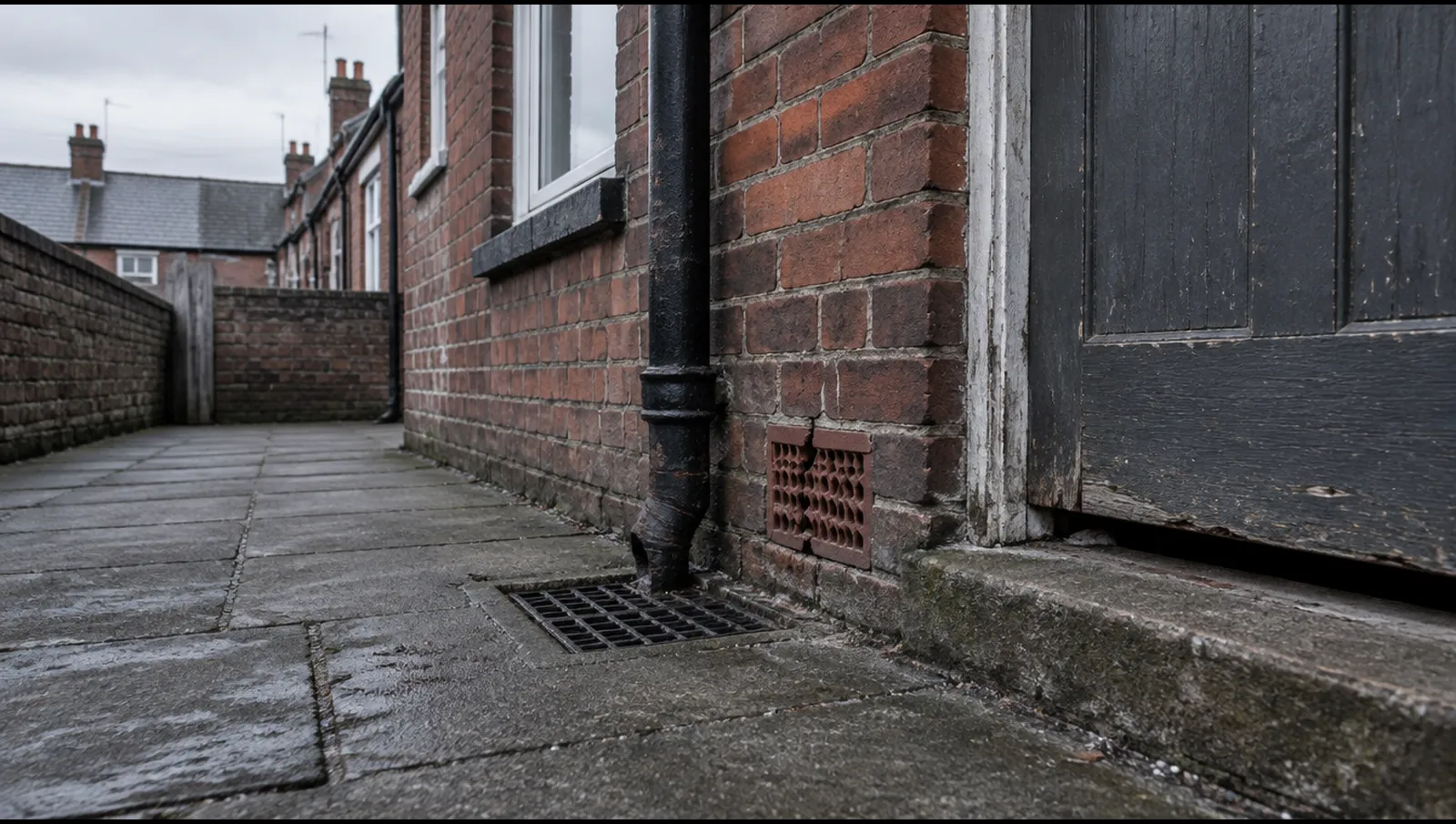
Rats get into a house through any gap of roughly 15mm or more, and in South Wales the route we find most often is a defective drain. After drains come airbricks, door thresholds, pipe and flue entries, suspended floor voids, party-wall voids and attached garages. Find the entry point first; treatment without proofing rarely lasts.
Introduction
You have found droppings behind the kitchen units, or heard something moving under the floor in the evening, and the first question is always the same. How are they getting in?
It is the right question. Bait and traps deal with the rats that are already inside. They do nothing about the route, and if the route stays open the problem comes back, usually in the same month next year. Every rodent survey we carry out across Cardiff, Newport, Swansea and the Valleys starts with the entry point, and this article walks you through the same checks in the same order.
We have ranked the seven entry points below by how often they turn up on South Wales surveys. The ranking reflects field experience, not a national statistic, and it reflects the housing stock we work in: Victorian and Edwardian terraces, 1930s semis and post-war estates, most of them with clay drains, suspended timber floors and shared walls.
Why does the entry point matter more than the bait?
Because the entry point decides what kind of job you actually have.
A rat problem that starts underground, in a cracked or displaced drain, is a different job from one that starts at a gap under the shed. The first needs a drain inspection and a permanent fix to the pipework. The second needs proofing and a short treatment. Put bait down for either without knowing which you have, and you are paying to treat the symptom.
That is also why we will not diagnose a rat problem over the phone. The survey tells us which of the seven routes is open, and that shapes everything that follows. If you want the background on why drain-fed and garden-fed infestations are handled differently, our guide on why a drain survey is not a rat survey covers it in detail.
How big a gap does a rat need?
An adult brown rat can pass through a gap of about 15mm, roughly the width of an adult thumb. If you can push your thumb into a hole, a rat can follow. A house mouse needs even less, around 6mm, which is why the pencil test below matters for both.
Rats also climb well, swim well and dig. A gap does not have to be at ground level to count. Flue outlets, cable entries at first-floor height and the eaves of an attached garage are all possible routes.
The Entry Point Walk-Round: seven places to check, in order
This is the walk that starts a rodent survey. You can do most of it yourself in about twenty minutes with a torch and a pencil. Do it in daylight, start at the drains and work upwards.
| Rank | Entry point | Why it is so common in South Wales homes | What to look for |
|---|---|---|---|
| 1 | Drains | Original clay pipework under period terraces cracks and shifts | Smear marks and droppings around the inspection chamber, a missing cap on an interceptor trap |
| 2 | Airbricks | Suspended timber floors need airbricks, and old terracotta ones break | Any gap a pencil fits through |
| 3 | Door thresholds | Back doors onto lanes and yards wear at the bottom | Daylight under the door, gnawed corners of the frame |
| 4 | Pipe and flue entries | Boiler flues, waste pipes and cables were cut through the wall years ago | Shrunk sealant, crumbling mortar around the pipe |
| 5 | Suspended floor voids | The void under a period ground floor connects to airbricks and drains | Noises under the floor, droppings at the edge of the carpet |
| 6 | Party-wall voids | Terraced roof spaces and floor voids often run between houses | Noise from the loft with no entry on your side |
| 7 | Garages and outbuildings | Open eaves, stored bird food and pet food, a gap under the up-and-over door | Gnawed feed bags, droppings on shelves |
1. Drains: the number one route in period terraces
Lift the inspection cover in the rear yard or the front garden and look before you do anything else. Most of the terraces in Newport, Cardiff and the Valleys were built with salt-glazed clay drains, and after a century of ground movement, tree roots and traffic, joints displace and pipes crack. A rat in the sewer follows the warmth and the food smell up a defective pipe and arrives under the house without ever crossing the garden.
What to look for: greasy smear marks around the benching of the chamber, droppings on the ledge, a redundant pipe that was capped badly when a bathroom was moved, or an interceptor trap with the rodding-eye cap missing. Any of those means the job starts underground.
The fix is a proper drain inspection, usually with a camera, then repair of the defect and, where appropriate, a one-way rat blocker fitted in the pipe. Our drain rat protection service covers this end to end, and our guide to rat blockers for drains explains when one is the right answer. It is the one entry point on this list we would never ask a homeowner to fix themselves.
2. Airbricks: do the pencil test
Walk the outside of the house at low level and find every airbrick. They ventilate the void under a suspended timber floor, and the original terracotta ones crack, lose bars or get knocked out by a wheelie bin. Hold a pencil against each one. Anything the pencil goes through, a mouse can use, and a broken bar is often wide enough for a rat.
The fix is a stainless steel mesh cover or a purpose-made airbrick guard. Never block an airbrick with mortar or foam to keep rats out. The void under your floor needs that airflow, and blocking it causes damp and timber rot, which is a far more expensive problem than the one you started with.
3. Door thresholds: daylight under the door is a rat door
Back doors onto the lane are the worst offenders. Timber swells and shrinks, the bottom rail wears, and the weather strip that was fitted twenty years ago has long gone. Close the door from inside on a bright day and look for daylight along the bottom edge. Check the corners of the frame for gnaw marks, which show as fresh pale wood with parallel tooth grooves.
The fix is a bristle strip or a steel kick plate along the bottom of the door, and a new threshold where the timber has gone. Garage side doors and the door from the garage into the house get the same check.
4. Pipe and flue entries: the sealant that shrank
Every boiler flue, waste pipe, overflow, cable and gas supply was cut through the wall at some point, and the sealant or mortar around it has been shrinking ever since. Run the torch around each one, inside and out. Under the kitchen sink is the classic spot: the waste pipe passes through the wall, the hole was cut oversize, and behind the cupboard back panel there is a gap you have never seen.
The fix is stainless steel wire wool packed into the gap and finished with a cement-based filler. Expanding foam on its own is not rat-proof; rats gnaw straight through it. Around a boiler flue, only seal the gap around the outside of the flue and never the flue terminal itself.
5. Suspended floor voids: the motorway under the house
The void under a period ground floor is warm, dry and dark, and it connects directly to the airbricks and, where a drain has failed, to the sewer. Once a rat is in the void it can reach the kitchen through the gap where pipes come up under the units, or through a service hole cut for the central heating.
You will not see the void without lifting a board, so listen instead. Movement under the floor in the evening, droppings along the skirting edge of the carpet, and a musty smell in one room are the signs. Inside the kitchen, pull out the kickboards under the units and check where the pipes rise through the floor.
The fix is to close the routes into the void (airbricks and drains, above) and then proof the openings from the void into the rooms, usually with mesh and filler around the pipe rises.
6. Party-wall voids: your neighbour's rats
In a terrace, the roof space and sometimes the floor void run along the row. Party walls were not always taken up to the underside of the roof, and where they were, they were rarely sealed. If you hear rats in the loft but cannot find an entry point on your own house, the entry point may be three doors down.
This one needs a conversation with the neighbours and, often, a survey of more than one property. Where a landlord owns several houses in the row, the sensible answer is a single survey of the block.
7. Garages and outbuildings: the food store
Attached garages and sheds are where rats find food and shelter before they find the house. Bird seed, pet food, a bag of compost, a chest freezer that seals badly. The up-and-over garage door rarely closes to the ground, the eaves are open, and from the garage the rat has a sheltered route to the house wall.
The fix is storage and proofing together: feed in sealed metal bins, a brush strip on the garage door, mesh under the eaves. If the garage is attached, treat the door between garage and house as an external door and check it the same way.
What are the warning signs that rats are already inside?
If the walk-round turns up an open route, these tell you whether it is already in use.
- Droppings: dark, spindle-shaped and roughly the size of a large grain of rice or bigger. Fresh ones are soft and dark; old ones are grey and crumbly.
- Smear marks: greasy dark rubs along skirting boards, pipes and the edges of holes, left by fur on regular runs.
- Gnaw marks: fresh pale wood on door corners, chewed cable insulation, holes in the corners of feed bags.
- Noise: scratching or scurrying in the evening and at night, under floors or in the loft. Our guide to scratching noises in the loft at night explains how to tell rats from mice, birds and squirrels by the timing.
- Burrows: holes about the width of a fist in soil next to walls, under decking or beside the drain run.
For the full list, see how to identify a rat infestation.
How do I stop rats getting into the house? The proofing checklist
Work through this after the walk-round. Tick each line only when it is done properly.
- Drain inspection chamber checked, no smear marks, all redundant branches capped correctly. Any doubt: book a camera survey.
- Every airbrick passes the pencil test, or has a mesh guard fitted.
- No daylight under any external door. Bristle strips fitted where needed.
- Every pipe, cable and flue entry sealed with wire wool and cement-based filler.
- Kickboards removed and pipe rises under the kitchen units sealed.
- Garage door closes to the ground, eaves meshed, feed stored in metal bins.
- Vegetation cut back from walls, decking edges checked for burrows, no food waste in open bags.
- Loft checked at the party walls; neighbours spoken to if the noise is in the row.
Our Ultimate Pest Prevention Guide For UK Homes covers the rest of the year-round checks.
When should I call a professional?
DIY proofing is worthwhile for airbricks, doors, pipe entries and outbuildings. It stops here:
- Anything involving the drain. Repairs, camera surveys and rat blockers need the right equipment and the right diagnosis. A blocker fitted in the wrong place can cause a blockage.
- An active infestation. Rodenticides are professional-use products for good reason. They carry real risks to children, pets and wildlife, and their use in the UK is governed by the rodenticide stewardship regime. Please do not put bait down in the open or at guessed quantities.
- Glue traps. In Wales the use of glue traps is an offence under the Agriculture (Wales) Act 2023. Do not buy them.
- Landlords. Under the Renting Homes (Wales) Act 2016 and the Fitness for Human Habitation (Wales) Regulations 2022, pests are one of the matters that can make a rented home unfit. A documented survey and proofing report protects both the property and the tenancy.
- You have done the walk-round and found nothing. That usually means the route is one you cannot see, and it is almost always the drain or the party wall.
At that point the next step is a survey. Our technicians find the entry point, fix it or specify the fix, treat what is inside and give you a fixed quote for the whole job before any work starts. Read more about rat control across South Wales, or if you are in the city, our Newport pest control page covers the areas we reach same-day.
Key takeaways
- In South Wales the most common rat entry point is a defective drain, followed by airbricks and door thresholds.
- A rat needs a gap of about 15mm; a mouse about 6mm. The pencil test on airbricks catches both.
- Do the walk-round in order: drains first, then airbricks, doors, pipe entries, floor void, party walls, garage.
- Never block an airbrick and never rely on expanding foam alone.
- Treatment without proofing is a subscription. Find the route, close it, then treat.
Frequently asked questions
How are rats getting into my house?
Most often through a defective drain under the property, then through broken airbricks, gaps under external doors, unsealed pipe and flue entries, the void under a suspended floor, shared walls in a terrace, or an attached garage. Walk the outside of the house at low level, starting with the drain inspection cover, and check each in turn.
Can rats come up through the toilet?
Yes, though it is less common than a defective pipe. Rats swim well and can travel through a drain run and up a pan if the water seal is disturbed or the pipework is damaged. A one-way rat blocker fitted in the main drain, after a camera survey, closes the route permanently.
Do rats climb walls to get into the loft?
They can. Rats climb rough render, ivy, drainpipes and cavity wall gaps, and they use flue outlets and eaves gaps at height. If you hear rats in the loft and cannot find a ground-level entry point, check the eaves, the soffits and the party walls with the neighbours.
Will filling holes with expanding foam keep rats out?
No. Rats gnaw through expanding foam easily. Pack the gap with stainless steel wire wool first, then finish with a cement-based filler or mortar. For airbricks use a purpose-made mesh guard so the ventilation is kept.
How do I know if the rats are coming from the drain?
Lift the inspection cover and look for greasy smear marks around the chamber, droppings on the benching, or a redundant branch that has been capped badly. Rats that keep returning after baiting, with no gaps found around the house, almost always point to the drain. A camera survey confirms it.
Ready to find your entry point?
Book a survey and get a fixed quote before any work starts. Call 02922 404605 or book online.
About the author
Gareth Davies is the owner of Pest & Property Solutions, a BPCA member firm covering Cardiff, Newport, Swansea and South Wales.

Written by
Gareth Davies
Owner of Pest & Property Solutions
Gareth owns and runs Pest & Property Solutions. He sets the service standards, leads on inspections and complex jobs, and makes sure every customer gets practical, honest advice.
Expertise: Rodent control, Commercial pest control, Drain surveys and RatGate systems, Property inspections, Prevention and proofing
View full profile