
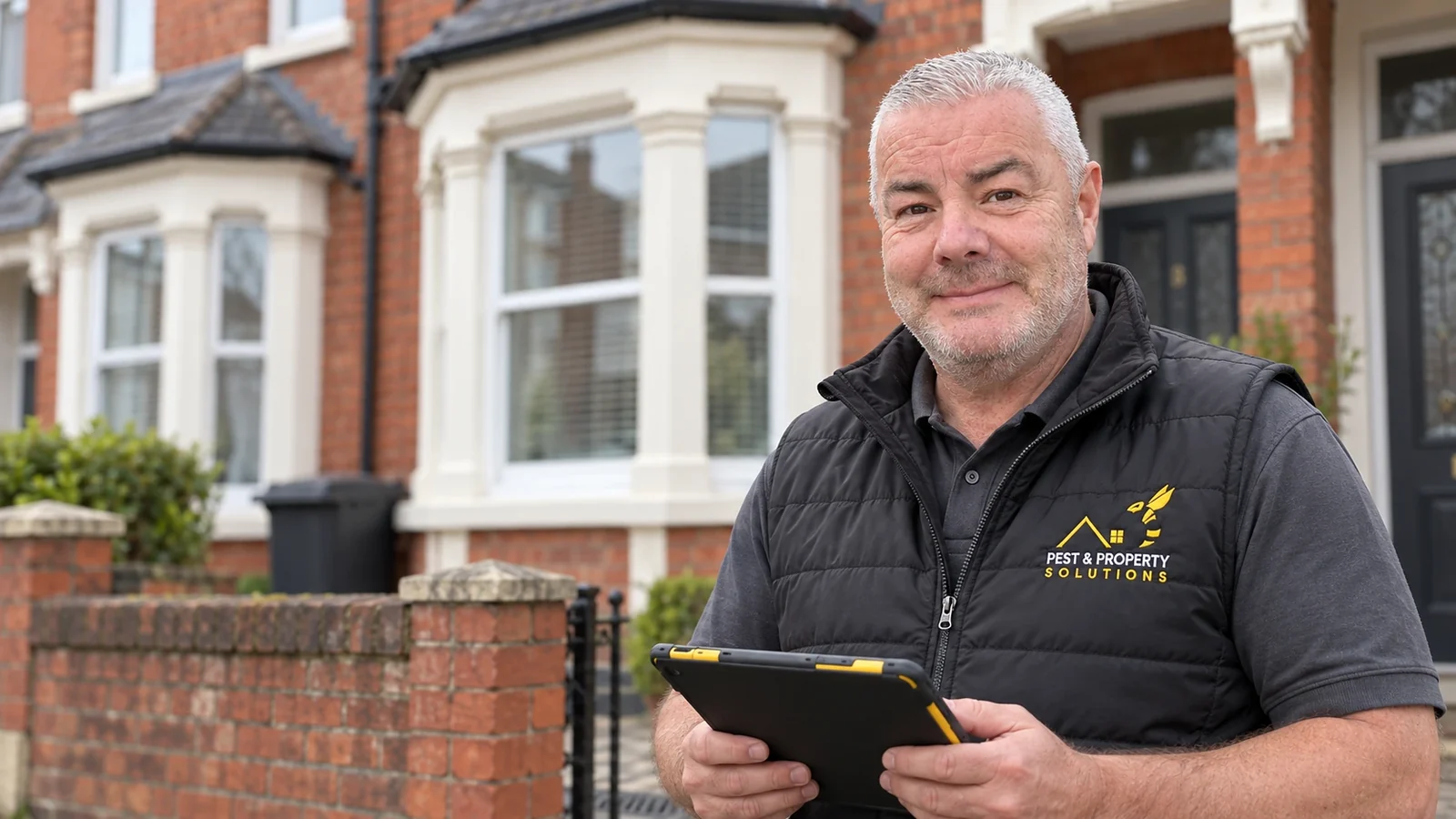
It is a fair question. The straight answer is that rat control cost in the UK is set by the job, not by the rat. Two houses on the same street in Cardiff can need completely different work, because the rats are getting in by different routes.
This guide explains the four things that decide the price of a rat job in South Wales, what a survey visit includes, and what a cheap job usually leaves behind, so you know what to ask for and how to get a fixed quote you can rely on.
Quick Answer: How Much Does Rat Control Cost?
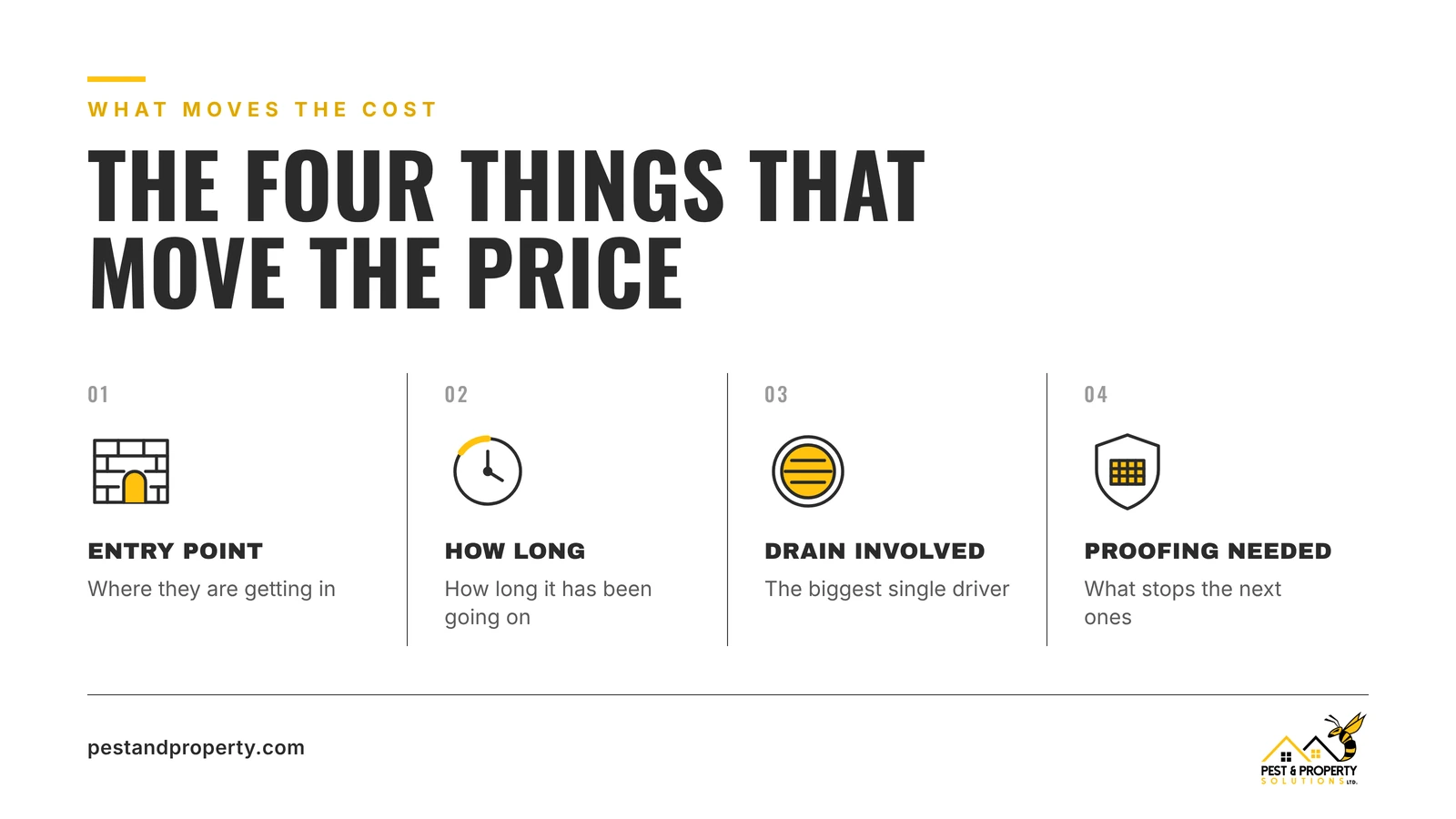
The cost of rat control depends on four things: where the rats are getting in, how long the problem has been going on, whether a drain is involved, and what proofing the property needs. A drain-fed infestation is a bigger job than a garden-fed one. A survey visit identifies all four, so you get a fixed quote before any work starts.
Why We Do Not Publish a Price List for Rat Control
Most people searching for a rat removal cost are hoping for a single number. But any price given before someone has looked at your property is a guess. Either it assumes the easy version of the job and the problem comes back, or it is padded to cover every possibility and you pay for work you did not need.
A fixed quote after a survey avoids both. That is how we price every rat job across South Wales, and it is why our rat control service always starts with a look at the property rather than a figure on the phone.
What Moves the Cost of Rat Control? The Four Drivers
Every rat job we price comes down to the same four questions, in the order we work through them on site.
1. Where are the rats getting in?
This decides everything else. A burrow under a shed or a hole at the base of a wall is a surface job. A broken airbrick or a gap around a service pipe is a proofing job. A defect in the drainage below the house is a different job again, and usually the biggest. Many properties have more than one route, and finding one while missing the other is the most common reason a treatment appears to fail.
2. How long has it been going on?
A problem caught early is usually a smaller, faster job. One that has run for months has had time to spread into wall cavities, floor voids and lofts, to breed, and to leave gnaw damage and contamination behind. That can mean more treatment visits and a clean-up before proofing can be done properly.
3. Is a drain involved?
This is the single biggest driver of cost in South Wales. If rats are coming up from the sewer through a defect in your private drainage, treating the ones you can see does not solve the problem. The route has to be found, sealed and protected. The British Pest Control Association estimates that around 80% of rat infestations originate from drainage issues (BPCA). Our experience across South Wales matches that closely.
4. What proofing does the property need?
Treatment removes the rats that are there; proofing stops the next ones getting in. That might be a few airbricks meshed and a waste pipe gap sealed, or it might be redundant pipes sealed in an inspection chamber, benching repaired and rat blockers fitted to the live drain inlets. The scope of the proofing is usually where two quotes for the "same" job differ most.
| Cost driver | What we check on site | Why it changes the job |
|---|---|---|
| Entry point | Walls, airbricks, roofline, service entries, drains | Decides whether the job is surface, structural or underground |
| How long it has been going on | Droppings, smears, gnaw damage, nesting, spread into voids | Longer problems need more treatment visits and often clean-up |
| Drain involvement | Inspection chambers, benching, redundant pipes, cover and frame | A drain route needs sealing and protection, not just treatment |
| Proofing needed | Age and construction of the property, past building work | Sets the materials, time and follow-up the fix requires |
Garden-Fed or Drain-Fed: Why They Are Different Jobs
If there is one thing to take from this guide, it is this. The single biggest driver of a rat job's cost in South Wales is whether the entry point is a drain defect, and a drain-fed infestation is a different job from a garden-fed one.
A garden-fed infestation starts outside. Rats are drawn in by bird feed, compost or open bins and get in through a weakness above ground. The fix is treatment, removing the food source and proofing the entry point. It is usually contained and predictable.
A drain-fed infestation starts underground. Rats come up from the sewer through a cracked clay pipe, an open redundant pipe in an inspection chamber, failed mortar or eroded benching. Treat every rat in the house and more arrive from the sewer. The fix is finding the defect, sealing it and protecting the live pipes, then treating what is already inside.
We cover the drainage side in why a drain survey is not a rat survey. The cost point is simple: a drain-fed job needs more investigation, more materials and sometimes a structural repair, and it is the job most often priced as if it were garden-fed.
Local spotlight: why South Wales housing leans towards drain-fed jobs
Much of Cardiff, Newport and the valleys towns is Victorian and Edwardian terracing on its original salt-glazed clay drainage. Clay is brittle, and a century of ground movement, tree roots and traffic produces cracked joints of exactly the size a rat needs.
Post-war and later estates across Barry, Caerphilly and the Vale of Glamorgan have been extended and re-plumbed many times, and each project risks leaving a redundant pipe open in an inspection chamber. It causes no drainage fault, so nobody notices. It only causes a rat problem.
Field note from Gareth: On a recent job the homeowner had dealt with rats on and off for five years. Under the chamber cover we found three redundant pipes left open, fresh droppings on the benching and a broken section of clay pipe. Years of treatment had never touched the route in. One morning of proofing closed it.
What Does a Survey Visit Include?
A survey is how we get from "I think I have rats" to a fixed quote. In order:
- 1
A conversation. Where and when you have seen or heard activity, what has been tried, and any recent building work. This alone often points to the route.
- 2
An external walk-round. The base of the walls, airbricks, gaps around pipes and cables, the roofline, sheds, and the garden for burrows, runs and food sources.
- 3
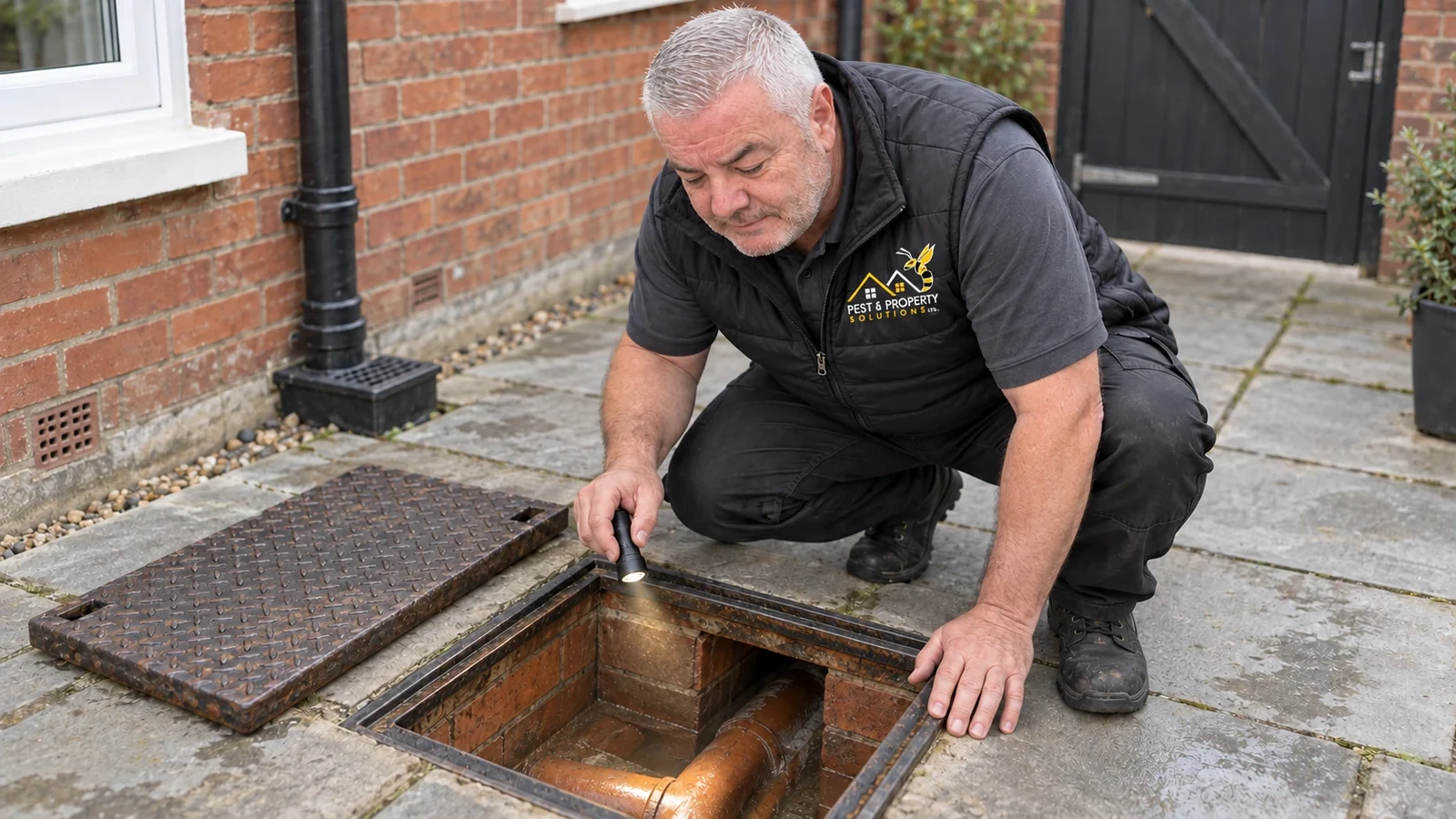
The drains. We lift the accessible inspection chamber covers and read what is inside: droppings, grease smears, open redundant pipes, and the condition of the benching, walls and cover frame.
- 4
The inside. Kitchen, under-sink areas, boiler cupboard, accessible floor voids and the loft, for droppings, gnaw marks, nesting and direction of travel.
- 5
A plan and a fixed quote. Where the rats are getting in, what will stop them and what it costs, with treatment, proofing and follow-up visits set out clearly.
The survey is also where we tell you if the job is smaller than you feared. Sometimes it is one entry point and a few changes in the garden.
If you already have droppings in the kitchen, a survey is the quickest way to find out which kind of job you have. You can book a survey online or call us on 02922 404605.
What a Cheap Rat Job Usually Misses
A low rat treatment price is not automatically a bad one. But when a job is priced to be quick, the same things get left out.
Myth: If the bait works, the problem is solved.
Reality: Bait removes the rats that are there. If the route is open, more arrive. Activity that stops and then returns is the classic sign of a route that was never found.
Myth: The drains were checked, so it cannot be the drains.
Reality: A CCTV drain survey grades the condition of the pipe. It is not designed to find rat entry points, and open redundant pipes are often not recorded because they cause no drainage fault.
What usually goes missing: no drain inspection (the covers are never lifted), no proofing (so the route stays open), no follow-up (nobody confirms the activity has stopped) and no written record, which landlords and letting agents in particular need.
The cheapest rat job is the one done properly once. The most expensive is the one done cheaply three times.
Warning Signs Your Rat Problem Is Getting Bigger
The longer a problem runs, the more it costs to put right. Stop waiting if you see:
- Droppings in new places, or in larger numbers
- Scratching below floor level, especially in a kitchen or ground floor extension
- Activity that returned after a previous treatment
- Gnaw marks on cables, pipes or skirting
- Rats in the garden near an inspection chamber, particularly at dusk
Our guide to the signs of a rat infestation walks through each one. There is a health reason not to leave it, too: rat urine can carry the bacteria that cause leptospirosis, also known as Weil's disease (NHS).
How to Keep the Cost Down Before We Arrive
A few safe steps today make the job smaller and the survey more useful:
- Take bird feeders down and clear fallen feed
- Put food waste and pet food in sealed containers, and keep bin lids closed
- Clear clutter from against the house walls and around sheds
- Note any gaps around airbricks or at the base of the walls
- Write down where and when you have seen or heard activity
- Tell us about any extensions, new bathrooms or kitchens in recent years
Two things not to do. Do not use glue traps: using or setting a glue trap is a criminal offence in Wales for everyone, professionals included, under the Agriculture (Wales) Act 2023, which came into force on 17 October 2023 (GOV.WALES). And do not bait a drain or lay bait openly in the garden. Rodenticides are covered by UK stewardship rules (CRRU Code of Best Practice) because badly placed bait puts children, pets and wildlife at risk. Do not climb into an inspection chamber or put your hands into standing waste water.
For a room-by-room approach, see our full pest prevention guide, or download our free rodent prevention guide from the resources page.
Who Pays for the Drain?
When a drain defect is involved, part of the fix may not be yours to pay for. Since the 2011 private sewer transfer, most shared drains and lateral drains beyond the boundary belong to the water and sewerage company. As a broad rule, pipework inside your boundary that serves only your property is yours. Your water company can confirm ownership for your address (GOV.UK).
Separately, the Prevention of Damage by Pests Act 1949 requires occupiers to tell the local authority in writing if they become aware of rats or mice on their land in substantial numbers (legislation.gov.uk).
For landlords in Wales: the Renting Homes (Wales) Act 2016 and the Renting Homes (Fitness for Human Habitation) (Wales) Regulations 2022 apply here, not the English rules. An unresolved infestation can affect whether a dwelling is fit for human habitation, and a written survey record gives you evidence of the action you took.
When to Call a Professional
Call us when any of the following is true:
- You have seen droppings, gnaw marks or rats inside the property
- Activity has come back after bait or a previous treatment
- You can hear movement under the floor or in the walls
- A drain survey came back clear, but the activity has not stopped
- You are a landlord or letting agent and need a written record of the work
Where DIY stops is simple: you can remove food sources and note what you see. Finding the route, working in drains, using professional rodenticides and proofing are jobs for a trained technician.
Get a Fixed Quote for Your Rat Problem
We will not give you a guess over the phone. We will come out, find where the rats are getting in, tell you what the job needs, and give you a fixed quote before any work starts. If a drain is involved, our drain rat protection work closes the route rather than treating the symptoms.
Call 02922 404605 or request a quote online. We cover Cardiff, Newport, Swansea and across South Wales.
Key Takeaways
- Rat control cost is set by four things: the entry point, how long it has been going on, whether a drain is involved, and the proofing needed.
- A drain-fed infestation is a different, bigger job from a garden-fed one, and it is the biggest single cost driver in South Wales.
- A survey visit covers the outside, the drains, the inside and ends with a fixed quote.
- Cheap jobs usually skip the drains, the proofing and the follow-up, which is why the rats come back.
- Glue traps are an offence in Wales, and bait should never be laid openly or in drains.
Frequently Asked Questions
How much does rat control cost in the UK?
It depends on the job rather than the number of rats. The four things that set the cost are where the rats are getting in, how long it has been going on, whether a drain is involved and what proofing is needed. A survey visit identifies all four, so you get a fixed quote before any work begins.
Why won't you give me a price for rat removal over the phone?
Because a phone price is a guess. Two similar houses can need very different work depending on the entry point, and a drain route changes the job completely. A price given without a survey is either too low to fix the problem or padded to cover every possibility. A fixed quote after a survey avoids both.
Is a drain problem more expensive to fix than rats in the garden?
Usually, yes. A garden-fed problem is treatment, removing food sources and proofing an entry point above ground. A drain-fed problem also means finding the defect, sealing redundant pipes, repairing benching and often fitting rat blockers to live pipes. It is the single biggest cost driver we see in South Wales.
What does a rat survey visit include?
A conversation about what you have seen, an external walk-round of the property, a check of the accessible drain inspection chambers, an inspection inside including the kitchen, voids and loft, and then a plan. You are told where the rats are getting in, what the job needs and the fixed cost before work starts.
Who pays for rat control in a rented home in Wales?
It depends on the tenancy and the cause. In Wales, the Renting Homes (Wales) Act 2016 and the fitness for human habitation regulations apply, and an unresolved infestation can affect whether a home is fit to live in. Where a drain is involved, pipework inside the boundary serving only that property is usually the owner’s responsibility.
![[Professional headshot of Gareth Davies, branded uniform, plain or on-site background]](https://media.base44.com/images/public/6a030ac59700caa462b5b7c5/a28541072_gareth-caricature-rat-rifle-solid-black-bg.png)
Author
Gareth Davies
Owner of Pest & Property Solutions
Gareth owns and runs Pest & Property Solutions. He sets the service standards, leads on inspections and complex jobs, and makes sure every customer gets practical, honest advice.
Expertise: Rodent control, Commercial pest control, Drain surveys and RatGate systems, Property inspections, Prevention and proofing
View full profile